Aggressive Dog Training in Charlotte: What You Need to Know
Mike and Colleen Bass
Dog Training

Key Takeaways
Reactivity and aggression need different approaches: reactivity responds to consistent, structured work, while true aggression often needs a veterinary behaviorist and medication alongside training.
A certified dog behaviorist evaluates medical causes, designs behavior modification plans, and can prescribe medication, while a trainer focuses on building your dog's skills.
Board & Train in Charlotte is a multi-week program priced after an assessment, and it works best for dogs that need daily repetition away from the triggers at home.
You're searching "aggressive dog training Charlotte" because your dog lunged at another dog on the sidewalk, barked through the window at a neighbor, or snapped when someone reached for their food bowl. That moment is unsettling, and plenty of Charlotte families have been exactly where you are. The word "aggressive" gets used for all of it, so the first step is knowing which one you're dealing with. A worried or frustrated dog responds well to dog training in Charlotte that teaches them what to do instead. A dog that's genuinely trying to cause harm may need a veterinary behaviorist and a safety plan first.
Reactivity vs aggression: What's the difference?
Reactivity is a dog's outsized response to a trigger (another dog, a skateboard, a person in a hat): barking, lunging, or pulling because they're anxious, frustrated, or overstimulated. Your dog wants the scary thing gone or wants to reach something exciting. Aggression is a dog trying to cause harm, and the warning signs are usually quieter: a stiff body, a hard stare, a low sustained growl, a snap that connects.
Most of what people call aggression in their own dog is reactivity, which is good news, because reactivity responds to structured work that gives your dog a better plan for the moment.

A trainer uses hand signals to direct a black and white dog sitting on a light wooden floor.
What does a dog behaviorist actually do?
If you're wondering whether your dog needs more than a trainer, start here. A certified dog behaviorist, meaning a veterinary behaviorist (DACVB) or a certified applied animal behaviorist (CAAB), first checks for a medical cause, since pain, thyroid issues, neurological conditions, and sensory decline all change behavior. They then build a behavior modification plan around your dog's triggers, usually with desensitization and counter-conditioning you'll practice at home. A veterinary behaviorist can also prescribe medication (anti-anxiety meds or SSRIs) that lowers your dog's baseline stress enough for training to take hold.
Behaviorists do their best work with true aggression, severe separation anxiety, and compulsive behaviors like tail-chasing. If your dog has bitten someone, or you're genuinely worried they might, a behaviorist is the right first call. Fees are set by each practice, usually an initial assessment plus follow-up visits. For a dog that lunges on-leash or barks at the door, a skilled trainer is usually the better fit.
How much does aggressive dog training cost in Charlotte?
Cost comes down to how much of a professional's time your dog needs. Here's how the four options compare:
Service | What drives the cost | What's included | Best for |
|---|---|---|---|
Private sessions | Per session or as a package; 4 to 6 sessions is common | A trainer works with you and your dog at home | Reactive dogs that are safe to work with |
Board and train (2 to 4 weeks) | Priced after an assessment, because program length depends on the dog | Your dog lives with the trainer full-time, trains daily, and you attend handoff lessons | Dogs that need daily repetition or live with constant triggers |
Veterinary behaviorist | Set by each practice: an initial consult plus follow-ups | Medical evaluation, behavior plan, medication if needed | True aggression, severe anxiety, compulsive behaviors |
Group classes | Usually the lowest cost per hour, since several dogs share the trainer | A 6-week series of weekly classes on obedience and socialization | Puppies or young dogs with mild reactivity; dogs with a bite history belong in private sessions |
If your dog has a bite history, start with the behaviorist row, and for everything else we're happy to help you choose.
What to look for in a Charlotte dog trainer
Plenty of trainers say they handle aggression, so here's how to find one who can genuinely help your dog:
Certification that's verifiable. Look for CPDT-KA (Certified Professional Dog Trainer, Knowledge Assessed), KPA CTP (Karen Pryor Academy Certified Training Partner), or IAABC membership (International Association of Animal Behavior Consultants). Each one is proof the trainer passed an exam, logs continuing education, and follows ethical standards.
They assess before they sell. A good trainer meets your dog, watches a reaction, and asks about bite history and vet records before quoting a package.
They talk about management as well as commands. Your dog needs a safety plan (baby gates, muzzle conditioning, leash handling that keeps tension off the neck) while the training builds.
They're honest about their limits. When a case calls for a behaviorist first, a good trainer tells you kindly and refers you on.
They explain the timeline. Reactivity work takes months, and fast fixes usually suppress the behavior while its cause stays in place, so it tends to come back.
Our dog training in Charlotte starts with an in-home assessment where we watch your dog in the environment where the behavior happens, because what a dog does at home and what they do on a training floor are often two different things, and we build the plan from there.
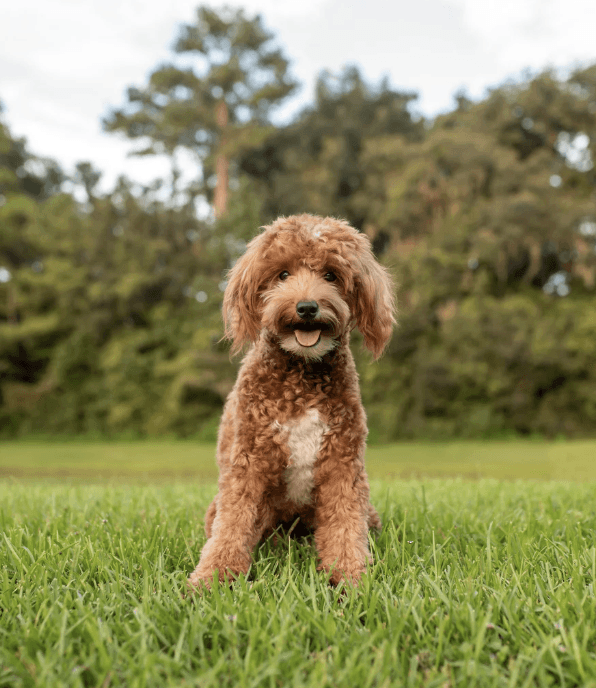
One apricot-colored dog with a curly coat sits on a grass field with green trees in the background.
Behavior issues we see most in Charlotte
Charlotte's a walking city, so your dog passes people, dogs, bikes, and runners every day. The most common behavior issues we see here are leash reactivity, door charging, and recall that falls apart around distractions.
Leash reactivity comes from one of two places: your dog wants to reach the other dog, or they're worried and want it gone. Frustration-based reactivity needs impulse control and a job to do, the same approach we use to move Myers Park dogs from frustration to focused walks. Fear-based reactivity needs distance and teaching your dog that other dogs predict good things.
Door charging calls for a door routine: where to go when the bell rings and how to hold a stay. Recall needs the most practice of all, building from the backyard until it holds when a squirrel appears.
When board and train makes sense
Weighing a few weeks away against training at home? Here's how to decide. Board & Train fits dogs that need intensive daily repetition, dogs that live with constant triggers, and dogs too reactive to train safely at home.
Some dogs do better staying home. Puppies under six months usually do best with in-home training, because they need to learn the rules of the house they actually live in. Senior dogs with health issues are often happier at home, too, and when the cause lives in your household (another dog bullying them, a chaotic routine), the change has to happen there.
Our Board & Train program is open to every Charlotte family, including families new to Pup Scouts. Your dog stays with a certified trainer, gets structured sessions every day, learns the basics in a low-distraction environment, and then we transition those skills back to your neighborhood through handoff lessons where you practice the handling.
Factor | Private at-home training | Board and train |
|---|---|---|
Timeline | 8 to 12 weeks of weekly sessions | 2 to 4 weeks intensive, plus handoff lessons |
Your involvement | High: you're at every session and practicing daily | Lower during the program, high during handoff and after |
Environment | Your home, your street, your triggers | Trainer's controlled environment, then back to yours |
The right path depends on your dog and your schedule, and we're always glad to talk it through with you.
What happens after the training ends
The training is the foundation, and your practice afterward decides whether it holds. If old habits creep back during a busy month, that's normal, because behavior is a skill that stays sharp through repetition. Run the door routine every time someone comes in, use your leash skills on every walk, and take recall from the backyard to the park on a long line. We'd love to help you and your dog become one of the teams whose training lasts.
Frequently Asked Questions
Can you train aggression out of a dog?
You can manage it, reduce it, and sometimes resolve it, depending on what's driving it. If the aggression is fear-based and your dog hasn't seriously bitten anyone, training that builds confidence can work well. With a bite history or predatory aggression, the goal is lifelong management through training, environmental setup, and sometimes medication, and a good trainer or behaviorist will tell you kindly where your dog falls.
How do I know if my dog needs a behaviorist or a trainer?
If your dog has bitten someone, shows aggression with no obvious trigger, or has severe anxiety or compulsive behaviors, start with a veterinary behaviorist. If your dog is reactive on-leash, door-charges, or has a shaky recall around distractions, a certified trainer can handle it. When in doubt, a trainer can assess your dog and refer you on.
Does board and train work for reactive dogs?
It works well for reactive dogs that lunge and bark but haven't bitten, because the trainer can work at a calm distance from triggers, away from the chaos of home. Dogs with true aggression or severe anxiety usually do better with a plan that keeps you present and adds medication.
What's the difference between a dog trainer and a veterinary behaviorist?
A dog trainer teaches skills (leash walking, recall, door manners) and helps you manage day-to-day behavior. A veterinary behaviorist is a vet who can diagnose medical causes, prescribe medication, and design plans for serious cases like aggression. Most dogs need a trainer, some need a behaviorist, and a few need both.
How long does it take to fix leash reactivity?
Anywhere from eight weeks to six months, depending on severity, practice, and what's driving it. Frustration-based reactivity usually improves faster than fear-based, and daily practice beats twice a week. Keep at it for a few months and you'll get there.
Written by Mike and Colleen Bass, founders of Pup Scouts. Mike and Colleen have led structured dog care since 2015, and they bring that same behavior-first approach to every Charlotte dog we train. More about our team.
We'd love to meet your dog and figure out what's driving the behavior. Get started with CLT Pup Scouts, or call (704) 330-3089. Find us on Google as CLT Pup Scouts.
Similar Blogs


