Board and Train Maryland: Live-In Dog Training Program
Mike and Colleen Bass
Board & Train

Key Takeaways
Board and Train is a 4-week live-in program where a dog stays with a certified Pack Leader and builds foundation behavior through structured daily routines.
Maryland is the only Pup Scouts market offering Board and Train. It addresses reactivity, impulse control, and recall for families who need accelerated results.
The program includes a family handoff session where the Pack Leader transfers every drill, cue, and routine directly to the household so behavior holds after the dog returns home.
A leash snaps taut on a Bethesda sidewalk. A dog lunges at a passing jogger. The handler pulls back, apologizes, shortens the leash another six inches. It happens again two blocks later. By the third walk that week, the handler is taking the route at 5:30 a.m. To avoid other dogs. This is the pattern families describe when they call about Board and Train. The behavior isn't new, but the management has stopped working. They need something different.
Board and Train in Maryland is a structured live-in program. A dog spends four weeks with a certified Pack Leader. Foundation behavior is built through daily routines. Leash work, recall, neutral passes around distractions, impulse control at thresholds. The dog returns home with the behavior in place, and the family receives a handoff session where every drill, every cue, and every routine is transferred directly to them. It is not a fix that happens to the dog while the family waits. It is a process that starts with the dog and finishes with the household.
Pup Scouts offers Board and Train exclusively in Maryland. The program addresses the cases where weekly sessions stretch too long or home distractions prevent progress. It is designed for families who need accelerated results and are ready to maintain what the dog builds during the stay.
Learn more about dog training in Maryland.
What Board and Train Is
Board and Train is a live-in training program where a dog stays with a certified Pack Leader for four weeks. The dog trains daily in real-world environments. Sidewalks with foot traffic, parks with off-leash dogs nearby, thresholds where delivery drivers knock. Foundation behavior is built through repetition in the moments that matter. The family receives progress updates throughout the month, and at the end of the stay, the Pack Leader conducts a multi-hour handoff session at the family's home. Every drill the dog knows is transferred to the handler. The family practices each cue with the dog while the Pack Leader observes and adjusts. The goal is not to send the dog home trained. The goal is to send the dog home with a routine the family can hold.
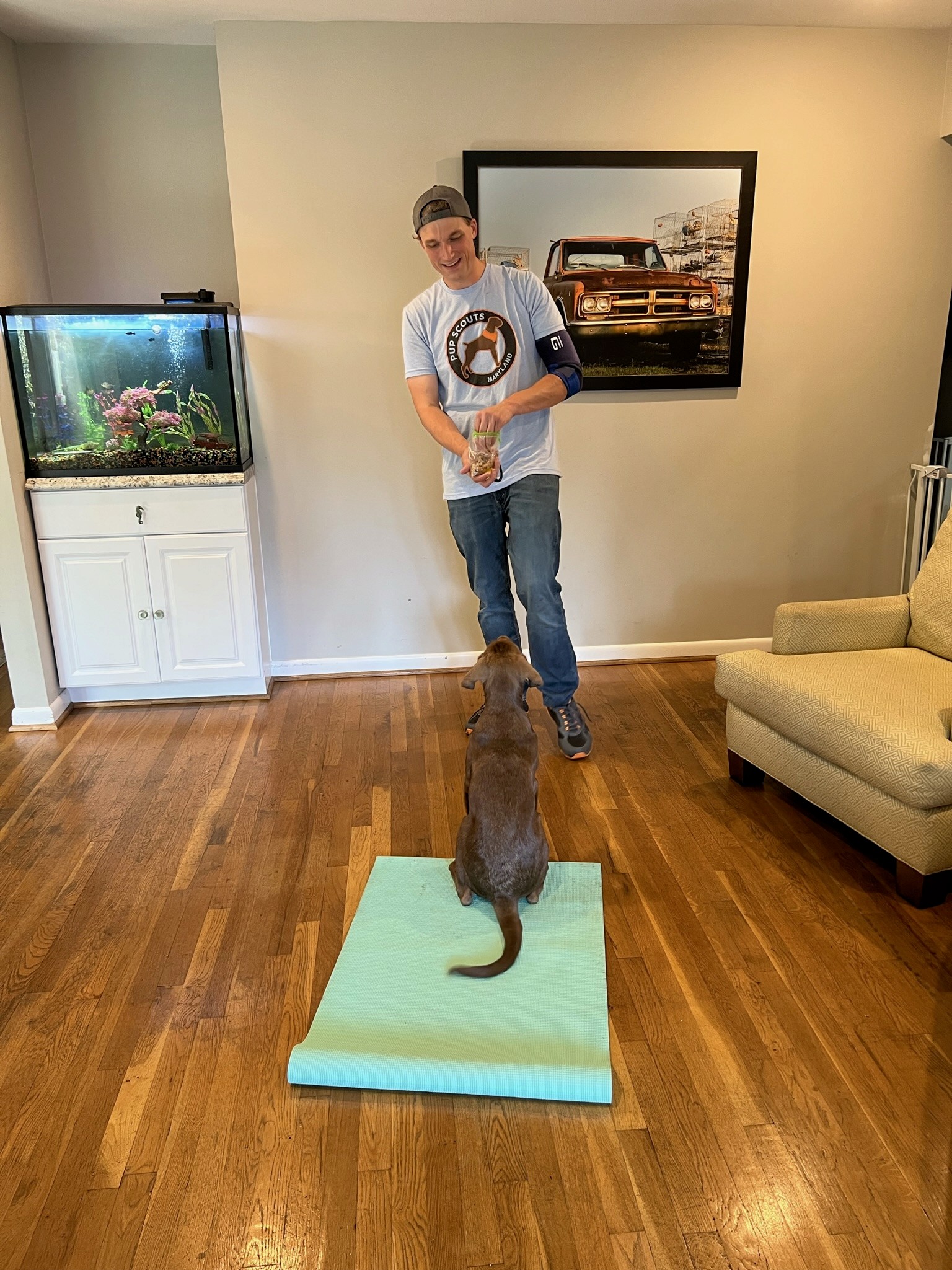
A Pack Leader works with a brown dog standing on a green mat in an indoor living space.
Who Board and Train Fits
Board and Train works for specific situations. It fits dogs with leash reactivity that has escalated past what management alone can address. It fits adolescent dogs who have impulse control gaps that weekly sessions cannot close quickly enough. It fits rescue dogs entering a new household who need a structured foundation before the family introduces their full routine. It fits families moving to Maryland from another state who want their dog to adjust to new density, new foot traffic, and new distractions before the household settles in.
The program does not fit every dog. Puppies under six months do better with in-home foundation work where the family participates from the start. Senior dogs with health limitations may not tolerate the intensity of daily training. Dogs with severe separation anxiety require a different protocol. The intake assessment determines fit. If Board and Train is not the right tool, we recommend the alternative that serves the dog better.
What the Family Receives
Families receive a structured package. The dog trains daily with a certified Pack Leader for four weeks. Progress updates are sent twice weekly with video clips showing specific drills. At the two-week mark, the family receives a mid-program call to review what is working and what adjustments are being made. At the four-week mark, the Pack Leader schedules a handoff session at the family's home. The session lasts two to three hours. The family practices every drill the dog knows. The Pack Leader watches, corrects timing, adjusts leash tension, and demonstrates the cues again until the handler can reproduce them without prompting.
The family also receives a post-program support window. For 30 days after the dog returns home, the Pack Leader is available for follow-up calls and short refresher visits if the dog starts reverting. Most families do not need the follow-up. The handoff session is thorough enough that the routine holds. But the safety net is there.
How Board and Train Differs From Weekly Sessions
Feature | Board and Train | Weekly In-Home Sessions |
|---|---|---|
Duration | 4 weeks live-in | 8 to 12 weeks, 1 session per week |
Environment | Real-world distractions daily | Family's home + neighborhood |
Repetition | Multiple daily practice rounds | Once per week with trainer, family practices between |
Family involvement | Handoff session at end | Present at every session |
Best for | Accelerated results, reactivity, impulse control gaps | Gradual foundation, families who want to participate weekly |
Weekly sessions work when the family has time to practice between appointments and the dog's behavior allows for incremental progress. Board and Train works when the dog needs concentrated repetition in varied environments and the family needs faster results. Neither replaces the other. They serve different timelines.
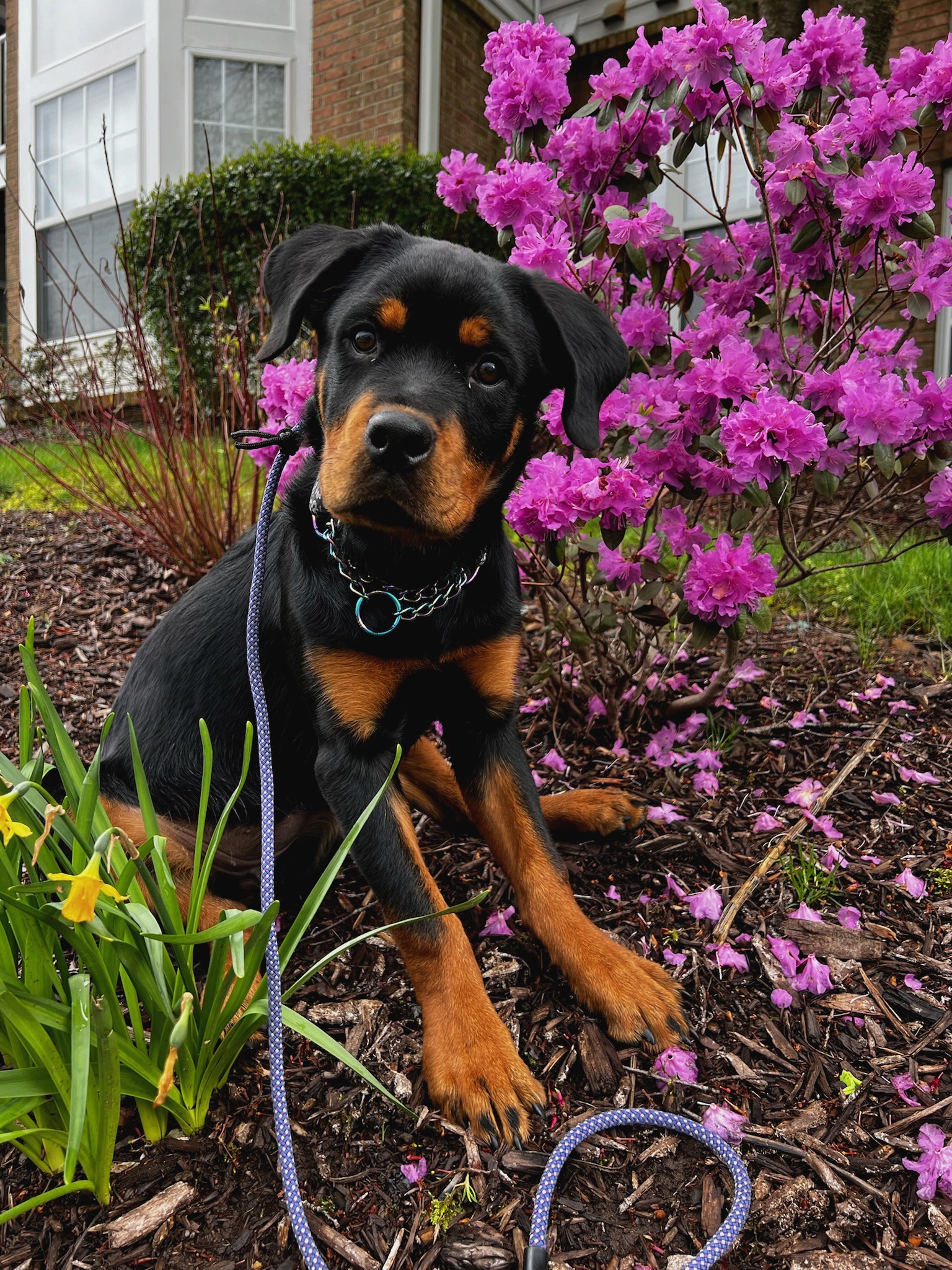
A black and tan dog stands on a mulched garden bed beside blooming pink flowers during an outdoor training session.
The 5-Step Board and Train Process
Board and Train follows a fixed sequence. Every dog moves through the same five steps.
Intake assessment. A certified Pack Leader visits the family's home. The dog is observed on leash, at the door when a visitor knocks, and around the family's daily triggers. The Pack Leader confirms fit and sets specific goals for the stay.
Immersion phase (Week 1). The dog adjusts to the Pack Leader's home. Routines are introduced. Leash work starts in low-distraction environments. Recall is practiced in a fenced area. The dog learns the daily rhythm before complexity is added.
Refinement phase (Weeks 2 to 3). Drills move to higher-distraction environments. The dog practices neutral passes on busy sidewalks. Recall is tested with other dogs visible nearby. Impulse control is reinforced at doorways, curbs, and transition points. Progress updates are sent to the family twice weekly.
Family return session (Week 4). The Pack Leader schedules a handoff session at the family's home. The dog demonstrates every drill. The family practices each cue under observation. The Pack Leader corrects timing, adjusts handling, and ensures the family can reproduce the routine without prompting.
Post-program support (30 days). The Pack Leader remains available for follow-up calls and short refresher visits. Most families do not need the follow-up, but the window is open.
Why Board and Train Is Maryland-Only
Board and Train requires infrastructure that Pup Scouts has built exclusively in Maryland. Certified Pack Leaders with the training to manage live-in stays operate in Anne Arundel, Howard, Baltimore, and Montgomery Counties. The network of low-distraction training environments, high-traffic practice routes, and off-leash recall spaces has been mapped and verified across the MD service area. The post-program support structure depends on proximity. A Pack Leader can return to a family's home in Bethesda or Severna Park within 48 hours if a refresher visit is needed.
Pup Scouts' other regions are not yet built out to deliver Board and Train at the same standard, so the multi-week live-in program stays a Maryland-exclusive service. Families elsewhere work with weekly in-home training sessions instead.
From Reactive Sidewalks to Calm Passes
A dog who lunged at joggers in Bethesda finishes Board and Train and walks Federal Hill at lunch hour without pulling. A rescue dog from a rural shelter adjusts to Towson foot traffic and learns to sit calmly when the mail carrier arrives. An adolescent lab who jumped guests at the door in Annapolis learns to hold a down-stay while visitors enter. The behavior that sent the family looking for help is replaced with a routine the family can hold.
Board and Train does not make a dog perfectly obedient. It builds the foundation the family needs to manage real-world moments without constant correction. The dog knows the cues. The family knows how to apply them. What happens after that depends on whether the household maintains the routine.
Not every dog needs a live-in program. For weekly work instead, see dog training in Annapolis and solving leash reactivity in Severna Park.
Frequently Asked Questions
What happens if my dog does not adjust well to the Pack Leader's home?
The intake assessment is designed to catch fit issues before the program starts. If a dog shows signs of severe separation anxiety or stress that does not resolve within the first 48 hours, the Pack Leader contacts the family immediately and the dog returns home. The family receives a full refund and a recommendation for an alternative protocol. This happens rarely, but the safety valve is built in.
Can I visit my dog during the 4-week stay?
Visits are not recommended. The dog adjusts faster to the Pack Leader's routine when the transition is clean. Mid-program visits can reset the adjustment period and delay progress. Families receive video updates twice weekly so they can see how the dog is doing. At the two-week mark, a progress call is scheduled to review what is working.
How do I know the behavior will hold after my dog comes home?
The handoff session is the key. The Pack Leader transfers every drill to the family in the home environment where the behavior will need to hold. The family practices each cue multiple times under observation. The Pack Leader corrects timing and adjusts handling until the family can reproduce the routine without prompting. The 30-day post-program support window is also available if the dog starts reverting.
What if my dog is reactive to other dogs. Can Board and Train address that?
Yes. Leash reactivity is one of the most common reasons families choose Board and Train. The dog practices neutral passes around other dogs daily in controlled environments. Distance is gradually reduced as the dog's threshold improves. By the end of the program, most reactive dogs can walk past another dog on a sidewalk without lunging or vocalizing.
Is Board and Train the same as a kennel stay with training added?
No. The dog lives in the Pack Leader's home, not a kennel facility. The dog sleeps in a crate in the Pack Leader's bedroom, eats on a set schedule, and trains multiple times daily in real-world environments. The setting is a household, not a boarding facility. The goal is to build behavior in the context where the dog will need to apply it.
Written by Mike and Colleen Bass, founders of Pup Scouts. Mike and Colleen have led structured dog care across Maryland, Orange County, and Charlotte since 2015. Board and Train has been part of the Maryland service lineup since 2016. More about our team.
Get started with MD Pup Scouts, or call (410) 980-7855. Find us on Google as MD Pup Scouts.
Similar Blogs


