Dog Training Lake Norman: In-Home vs Group Classes
Mike and Colleen Bass
Dog Training

Key Takeaways
In-home dog training works best for anxious, reactive, or highly distracted dogs who need focused repetition without competing stimuli.
Group obedience classes build social confidence and work well for social dogs, puppies learning foundational manners, and families with consistent weekly availability.
Lake Norman's neighborhoods (Davidson, Cornelius, Mooresville, Huntersville) each present distinct training environments: waterfront trails, suburban sidewalks, town-center foot traffic, and lakefront parks.
Families move to Lake Norman for the water, the trails, and the neighborhoods that feel both close-knit and spacious. Dogs move here too. A golden retriever learning to ignore ducks along the Davidson greenway. A young shepherd navigating Birkdale Village foot traffic in Huntersville. A rescue terrier adjusting to Cornelius sidewalks after months in a shelter kennel. Each dog needs training. The question most Lake Norman families ask first is not what to train, but where: in-home sessions with a private trainer, or weekly group classes at a local facility.
The answer depends on the dog's current behavior, the family's weekly bandwidth, and the specific distractions the dog will face in daily Lake Norman life. Dog training in Charlotte at Pup Scouts offers both formats, tailored to each household.
What In-Home Dog Training and Group Classes Actually Do
In-home dog training is one-on-one instruction that happens in the dog's home environment or on the routes the family actually walks. A trainer works directly with the dog and the family, addressing specific behaviors in the locations where those behaviors occur. Group obedience classes are structured weekly sessions at a training facility where 6 to 10 dogs and their handlers practice foundational skills together under instructor guidance.

Consistent repetition in familiar environments builds confidence and reinforces commands during dog training sessions.
The Core Difference: Environment and Repetition
In-home training controls the environment. The dog learns leash manners on the exact sidewalk where pulling happens. Doorway calm gets practiced at the family's actual front door. Recall drills happen in the backyard or the neighborhood park the family uses three times a week. The trainer can isolate variables, repeat the drill until it holds, and then add distractions incrementally.
Group classes introduce controlled distraction early. Six dogs in a room means six competing scents, six movement patterns, six potential social cues. For a dog already comfortable around other dogs, this becomes useful exposure. For a dog who tenses at the sight of another dog across a parking lot, the group format can overwhelm before foundational skills are in place.
Lake Norman neighborhoods vary in distraction density. Davidson's walkable downtown has consistent foot traffic, outdoor dining, weekend cyclists. Cornelius offers quieter residential loops but busy intersections near major shopping centers. Mooresville blends industrial areas with suburban pockets. Huntersville's Birkdale Village sits between a lakefront park and retail corridors. The training format that works depends on where the dog actually needs to perform.
Decision Matrix: Which Format Fits Which Dog
The table below maps five common Lake Norman dog profiles to the format that typically produces faster, more reliable results.
Dog Profile | In-Home Training | Group Class | Why |
|---|---|---|---|
Anxious or fearful dog | ✅ Best fit | ⚠️ Often too much | Anxious dogs need calm repetition without competing stimuli. Group settings can spike cortisol before skills form. |
Leash-reactive dog | ✅ Best fit | ❌ Not recommended | Reactive dogs need distance from triggers while learning alternate responses. Group classes put dogs too close too soon. |
Social, confident dog | ✅ Works well | ✅ Works well | Social dogs benefit from both. In-home refines household manners; group class builds focus amid distraction. |
Puppy (8 to 16 weeks) | ✅ Good for basics | ✅ Best for socialization | Puppies need early exposure to other dogs. Group puppy classes provide controlled socialization in-home can't replicate. |
Adolescent dog with inconsistent recall | ✅ Best fit | ⚠️ Limited transfer | Recall needs high repetition in the exact locations the dog will be off-leash. Group facilities don't replicate lakefront parks or neighborhood trails. |
How In-Home Training Works in Lake Norman Neighborhoods
In-home sessions run 60 to 90 minutes and typically happen once or twice per week for 4 to 6 weeks. The trainer meets the family at home, observes the dog's current behavior, and builds a training plan around the household's actual routines.
Week 1: Foundation work indoors. Eye contact on cue. Sit and down with duration. Doorway protocols for visitors or deliveries. The trainer teaches the family how to mark correct behavior and how to interrupt unwanted behavior without escalation.
Week 2: Leash work begins on the family's usual route. For a Cornelius household, that might be the residential loop around Nautique Lakes. For a Davidson family, the greenway from Griffith Street down to the waterfront. The trainer works the dog on-leash, then hands the leash to the owner mid-walk to practice real-time coaching.
Week 3 to 4: Distraction exposure. The trainer brings the dog to higher-traffic areas incrementally. A Huntersville family might progress from quiet residential streets to Birkdale's outdoor shopping corridors. A Mooresville household might work up to the busier sections of downtown. Each session ends with a homework drill the family practices daily.
Week 5 to 6: Off-leash recall work in fenced areas or long-line practice in open parks. Lake Norman Regional Park in Cornelius, Robbins Park in Mooresville, or Fisher Farm Park in Davidson all provide controlled off-leash environments where distance recalls can be built and tested.
The advantage of in-home training is precision. If the dog pulls toward every other dog on the Cornelius greenway, the trainer can drill neutral passes on that exact greenway until the behavior shifts. If the dog barks at the doorbell, the trainer works the doorbell response at the actual door, not a simulated scenario in a facility.
How Group Obedience Classes Work
Group classes meet weekly for 60 minutes over 6 to 8 weeks. Class size typically ranges from 6 to 10 dogs. Each session covers a specific skill set: week one might focus on sit, down, and stay; week two adds loose-leash walking; week three introduces recall foundations.
The class environment is intentionally distracting. Dogs work in proximity to other dogs. Instructors create controlled chaos: handlers walking in circles, dogs practicing stays while other dogs move past them, recall drills with multiple dogs returning to their handlers simultaneously.
For dogs who are already neutral around other dogs, this distraction becomes useful. A confident dog learns to hold a sit-stay even when another dog walks within three feet. A social puppy learns that not every dog in the room is available for play. The group format teaches focus amid competing stimuli.
Group classes also provide social accountability. Families commit to a weekly schedule, practice homework between sessions, and see other households working through similar challenges. The structure works well for families who need external deadlines to stay consistent.
The limitation of group classes is transfer. A dog who holds a perfect sit-stay in a training facility may still pull on the leash during a Saturday morning walk through Davidson's farmers market. The facility environment does not replicate the scents, sounds, and movement patterns of real Lake Norman daily life. Families often need to bridge the gap between class performance and home performance on their own.
What Lake Norman Families Actually Need Training For
The behaviors Lake Norman families most commonly request help with fall into three categories: leash manners on multi-use trails, household calm during high-traffic times (morning routines, evening arrivals, weekend guest visits), and recall reliability near water.
Leash manners: Lake Norman's greenways and waterfront trails see walkers, runners, cyclists, strollers, and other dogs. A dog who pulls makes these routes stressful. In-home training addresses pulling directly on the family's usual route, building loose-leash habits where they will actually be used.
Household calm: Doorbell reactivity, jumping on guests, counter-surfing during meal prep. These behaviors happen at home. Group classes teach general impulse control, but the specific triggers (the family's actual doorbell, the family's actual kitchen layout) require in-home repetition.
Recall near water: Lake Norman dogs often have access to lakefront parks or private docks. Off-leash reliability near water requires distance work in the actual environment. Group facility recall does not transfer directly to a dog standing at the edge of Lake Norman with ducks 20 feet offshore.
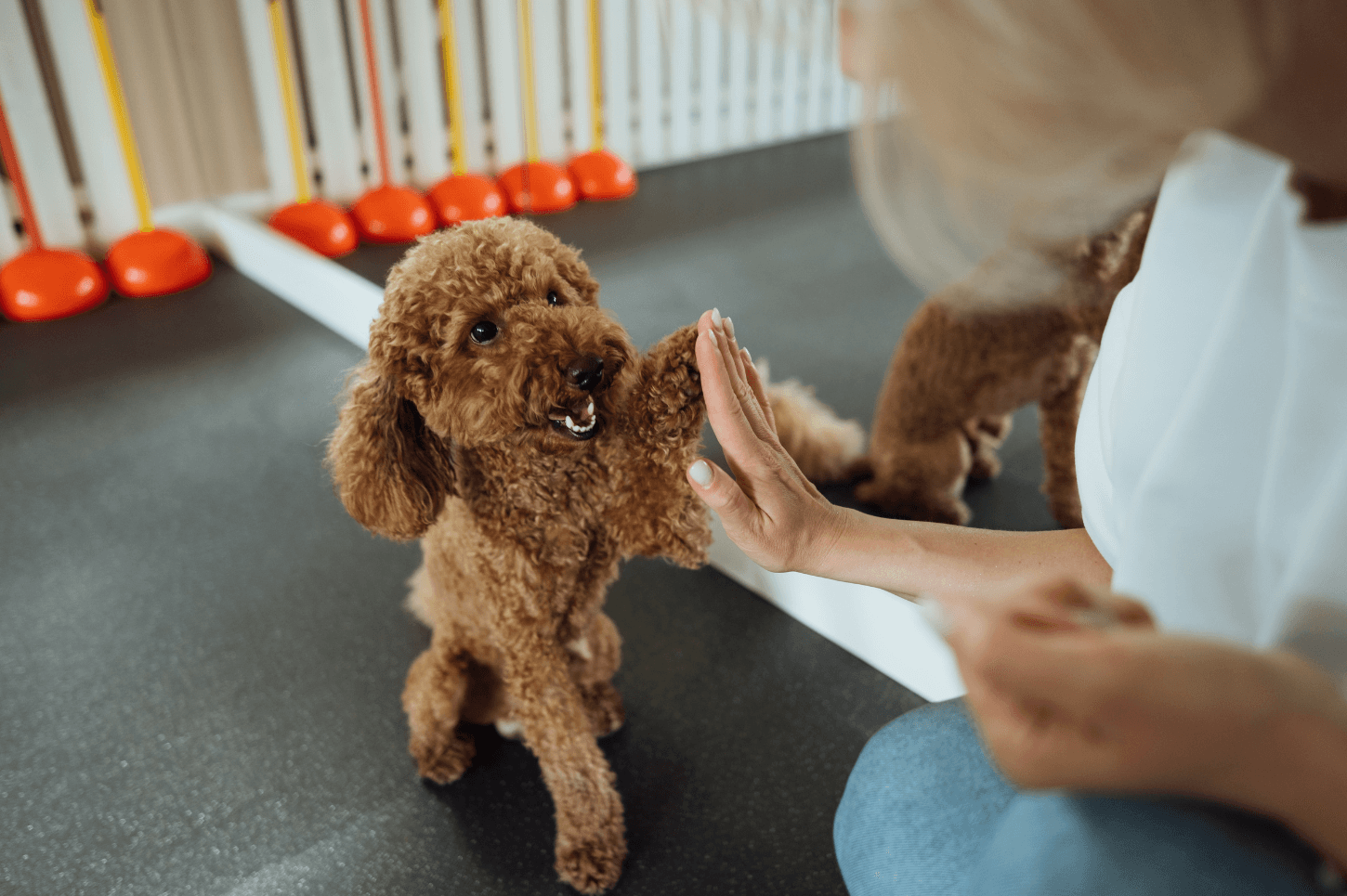
One-on-one training allows our Pack Leaders to focus entirely on your pup's unique learning style and needs.
When to Choose In-Home Training
In-home training fits best when the dog's primary challenges are location-specific, when the dog is anxious or reactive around other dogs, or when the family's schedule does not support a fixed weekly commitment.
A rescue dog adjusting to Huntersville sidewalks after months in a kennel benefits from calm, repetitive leash work on quiet residential streets before progressing to busier areas. A dog who lunges at other dogs on the Cornelius greenway needs distance and controlled exposure, not immediate proximity to six dogs in a training room. A family with irregular work schedules values the flexibility of scheduling sessions around their availability rather than committing to a fixed class time.
In-home training also works well for multi-dog households. The trainer can address the dynamics between the household's dogs directly, something group classes cannot replicate.
When to Choose Group Classes
Group classes work best for social dogs who need generalized obedience foundations, for puppies in the critical socialization window (8 to 16 weeks), and for families who value structured weekly accountability.
A 10-week-old Labrador retriever in Davidson benefits from controlled exposure to other puppies, new people, and novel surfaces. A confident adult dog who already walks politely on-leash but needs to learn sit, down, stay, and come can build those skills efficiently in a group format. A family who struggles with consistency at home may find that the weekly class structure and homework assignments keep training on track.
Group classes also cost less per session than in-home training. For families on a budget who have a dog suited to the group format, the cost difference can be significant.
Combining Both Formats
Some Lake Norman families start with in-home training to address specific behavioral challenges, then transition to group classes for ongoing skill-building and socialization. A dog who enters training with leash reactivity might need 4 to 6 weeks of in-home work to build neutral-pass skills on neighborhood routes. Once reactivity is managed, the same dog could benefit from a group obedience class to practice focus amid distraction.
Other families use group puppy classes for early socialization, then bring in an in-home trainer later to address adolescent behaviors that emerge around 8 to 12 months (selective recall, increased pulling, doorway reactivity).
The two formats are not mutually exclusive. Each serves different training goals.
What to Expect in the First Session (Either Format)
In-home first session: The trainer meets the family at home, observes the dog's behavior in the household, asks about the family's goals and daily routines, and demonstrates the first few training exercises. The family practices under the trainer's guidance. The session ends with a homework plan: specific drills to practice daily before the next session. Duration: 60 to 90 minutes.
Group class first session: The instructor explains class structure, demonstrates proper leash handling and treat delivery, and introduces the first skill (typically sit or down). Dogs practice the skill individually while other dogs wait. Handlers receive feedback on timing and body language. The session ends with a homework sheet outlining what to practice before the next class. Duration: 60 minutes.
Both formats require daily practice between sessions. Training does not happen only during the hour with the instructor. The instructor teaches the technique; the family builds the habit through repetition.
For more on how we build behavior in this market, see our Charlotte dog training guide and dog training in Elizabeth.
Frequently Asked Questions
Can my dog do group classes if they are nervous around other dogs?
Group classes are not recommended for dogs who show fear, anxiety, or reactivity around other dogs. The proximity to multiple dogs in a confined space can increase stress rather than build confidence. In-home training allows the dog to build foundational skills in a calm environment first, then introduce controlled exposure to other dogs incrementally once those skills are solid.
How long does it take to see results with in-home training?
Most families see noticeable improvement within 2 to 3 weeks if they practice the assigned drills daily. Leash pulling typically improves within the first week of consistent work. Doorway calm and recall reliability take longer, often 4 to 6 weeks of repetition. The timeline depends on the dog's age, the behavior being addressed, and the family's consistency with homework.
Do group classes work for older dogs or only puppies?
Group classes work for dogs of any age as long as the dog is comfortable around other dogs and can focus in a distracting environment. Many facilities offer separate classes for puppies, adolescent dogs, and adult dogs to match skill level and energy. Older dogs often learn quickly in group settings because they have longer attention spans than puppies.
What happens if my dog does not do well in a group class?
If a dog struggles in a group class (excessive barking, inability to focus, heightened anxiety), the instructor will typically recommend switching to in-home training or working with a private trainer to address the underlying issue before returning to a group format. Most reputable training facilities will work with families to find the right fit rather than insisting on a format that is not working.
Can I do both in-home training and group classes at the same time?
Yes. Some families use in-home training for specific behavior challenges (leash reactivity, separation anxiety) while attending group classes for general obedience and socialization. The key is ensuring the two trainers are aligned on methods and terminology so the dog does not receive conflicting cues. Most in-home trainers and group instructors are willing to coordinate if asked.
Written by Mike and Colleen Bass, founders of Pup Scouts. Mike and Colleen have led structured dog care across Maryland, Orange County, and Charlotte since 2015. More about our team.
Get started with CLT Pup Scouts, or call (704) 330-3089. Find us on Google as Pup Scouts Charlotte.
Similar Blogs


