Dog Walking in OC: Why Pack Size Caps at 8 Dogs
Mike and Colleen Bass
Pack Walking

Key Takeaways
Pup Scouts caps every Pack Walk at 5 to 8 dogs across Orange County. Above 8, the certified Pack Leader's attention fragments. Below 5, the social learning that makes pack walking work starts to thin.
Pack composition is not random. Each dog goes through an in-home assessment before being placed in a temperament-matched pack of 5 to 8 compatible dogs.
The cap holds across both Pack Walking tiers: the 60-minute Explorer Hour and the 4-hour Scout Expedition. Pack size is the variable Pup Scouts holds steady regardless of route or duration.
A pack walk with twelve dogs isn't a pack walk. It's a herd. The certified Pack Leader stops being a leader and starts being a babysitter. Behavior signals get missed. Reactive moments compound. Confidence stops building. That's why Pup Scouts caps every Pack Walk at 5 to 8 dogs across Orange County, from Newport Beach driveways to Laguna Beach trails to San Juan Capistrano residential blocks.
The cap isn't a marketing detail. It's a behavior decision that shapes everything downstream: how the walk feels, how the dogs progress, whether your family experiences calm or chaos at drop-off. Above 8 dogs, attention fragments. Below 5, the social learning that makes pack walking worth choosing over a private walk starts to thin. The middle is where structure lives.
Pack Walking Adventures across Orange County is built around that middle. The two formats Pup Scouts runs (the 60-minute Explorer Hour and the four-hour Scout Expedition) both honor the cap. The route changes. The duration changes. The pack size doesn't.
Pack composition: what it actually means
Pack composition is the practice of grouping dogs by temperament, energy level, and social fit before any walk begins. At Pup Scouts, every dog goes through an in-home assessment first. The certified Pack Leader uses that assessment to assign the dog to a pack of 5 to 8 compatible dogs, not rotating dogs through whichever group has open slots that day. The match is the service. Without it, you have a group walk. With it, you have a Pack Walk.
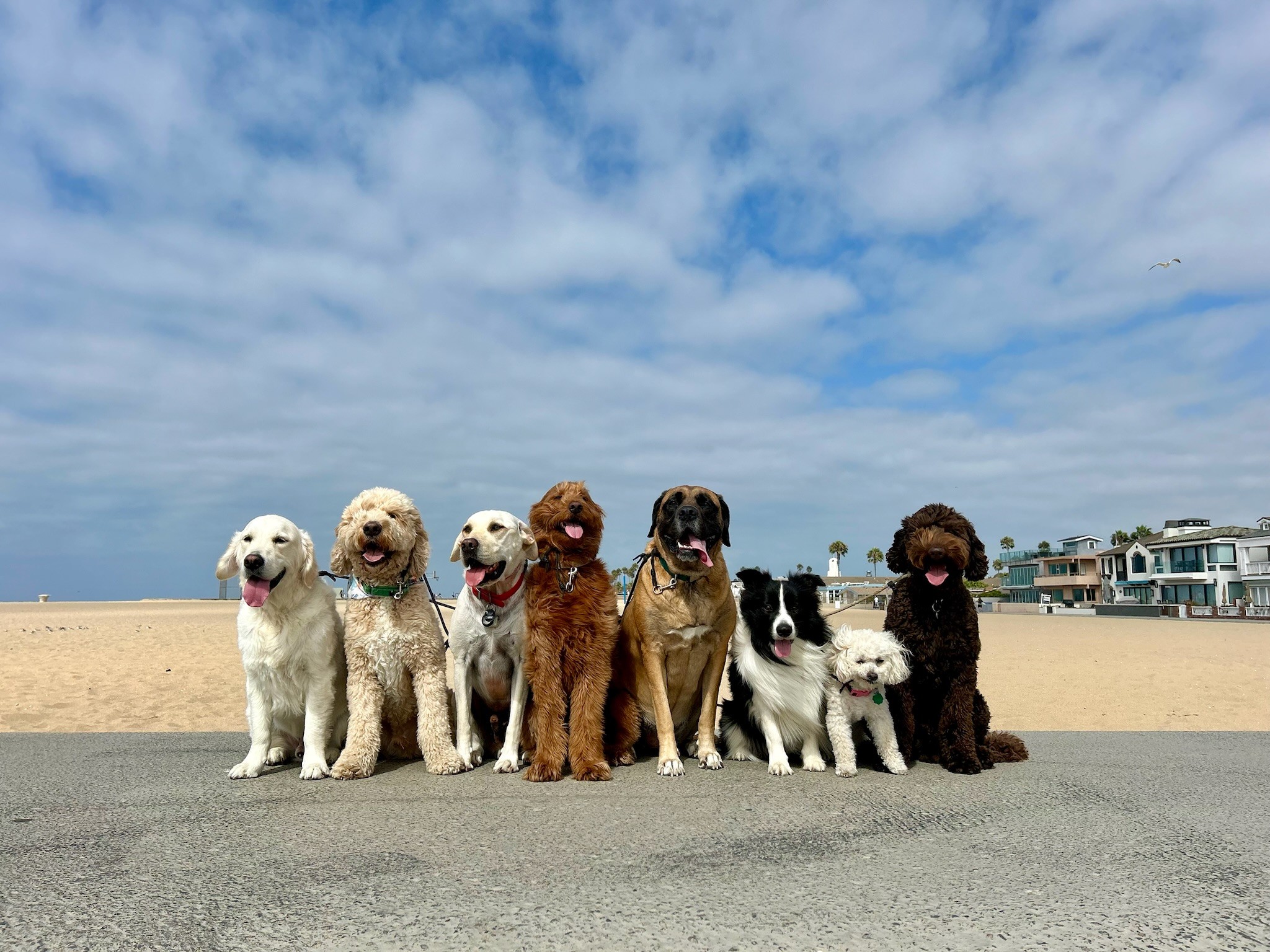
A properly sized pack walk allows each dog individual attention while enjoying socialization with other dogs.
Why 5 to 8 dogs is the right number
The number lives in the gap between two failure modes.
Above 8 dogs: the certified Pack Leader's attention fragments. Some dogs become invisible. Behavior issues compound before they get caught. A reactive moment from one dog cascades through a group too large to redirect.
Below 5 dogs: the social learning thins. Peer modeling is one of the reasons pack walks work. A shy dog watching four confident peers move calmly past a stimulus learns differently than a shy dog watching one peer. Solo walks have their place (Pup Scouts runs Private Walks for that), but they aren't pack walks.
Five to eight is where the certified Pack Leader can read every dog in real time, redirect early, and let peer learning happen without losing control.
What "matched by temperament" looks like in Orange County
An Orange County pack rarely looks like a random sample of OC dogs. Each pack has a profile.
A Newport Beach morning pack might be five confident social dogs ready for a 60-minute Explorer Hour through residential blocks. A Laguna Beach midday pack might be six high-energy adolescents on a Scout Expedition through trail terrain. An Irvine family pack might be five matched-pace seniors on a calm route. The composition shapes the pace, the route, and the kind of behavior the walk can support.
Mixing the wrong dogs is what creates the chaos people associate with group walks. A reactive dog placed with five high-energy retrievers escalates. A senior placed with juvenile fast-pace dogs falls behind. None of those packs work, and none of them should exist.
How does Pup Scouts decide which pack a dog joins?
The decision starts with the in-home assessment, where a certified Pack Leader visits the dog at home. The visit covers temperament observation, leash behavior, and how the dog responds to novelty in familiar space. From that read, the Pack Leader identifies which existing pack matches the dog's profile.
Most new dogs don't get dropped into a full pack of 8 on day one. The first walk is often one-on-one with the Pack Leader, or with a single calm peer the Pack Leader knows will set the right tone. That first walk is calibration data, not the real pack walk yet. Once it goes well, the dog joins the matched pack at the next opening.
Pack profiles you'll see in Orange County
Pack profile | Composition | Best Pack Walking format |
|---|---|---|
Confident social | Mixed energy levels acceptable | Either Explorer Hour or Scout Expedition |
Recovering reactive | Calm peers only, often a smaller pack of 5 to 6 | Explorer Hour first, Scout Expedition once stable |
High-energy adolescent | Matched-energy peers | Scout Expedition (4-hour outing absorbs the energy) |
Senior with mobility limits | Calm peers, slower pace, shorter routes | Explorer Hour, light route |
First-week new dog | Single experienced peer at most | One-on-one before any pack entry |
Reactive but recoverable | Carefully chosen calm matches | Explorer Hour with assessment-led pacing |
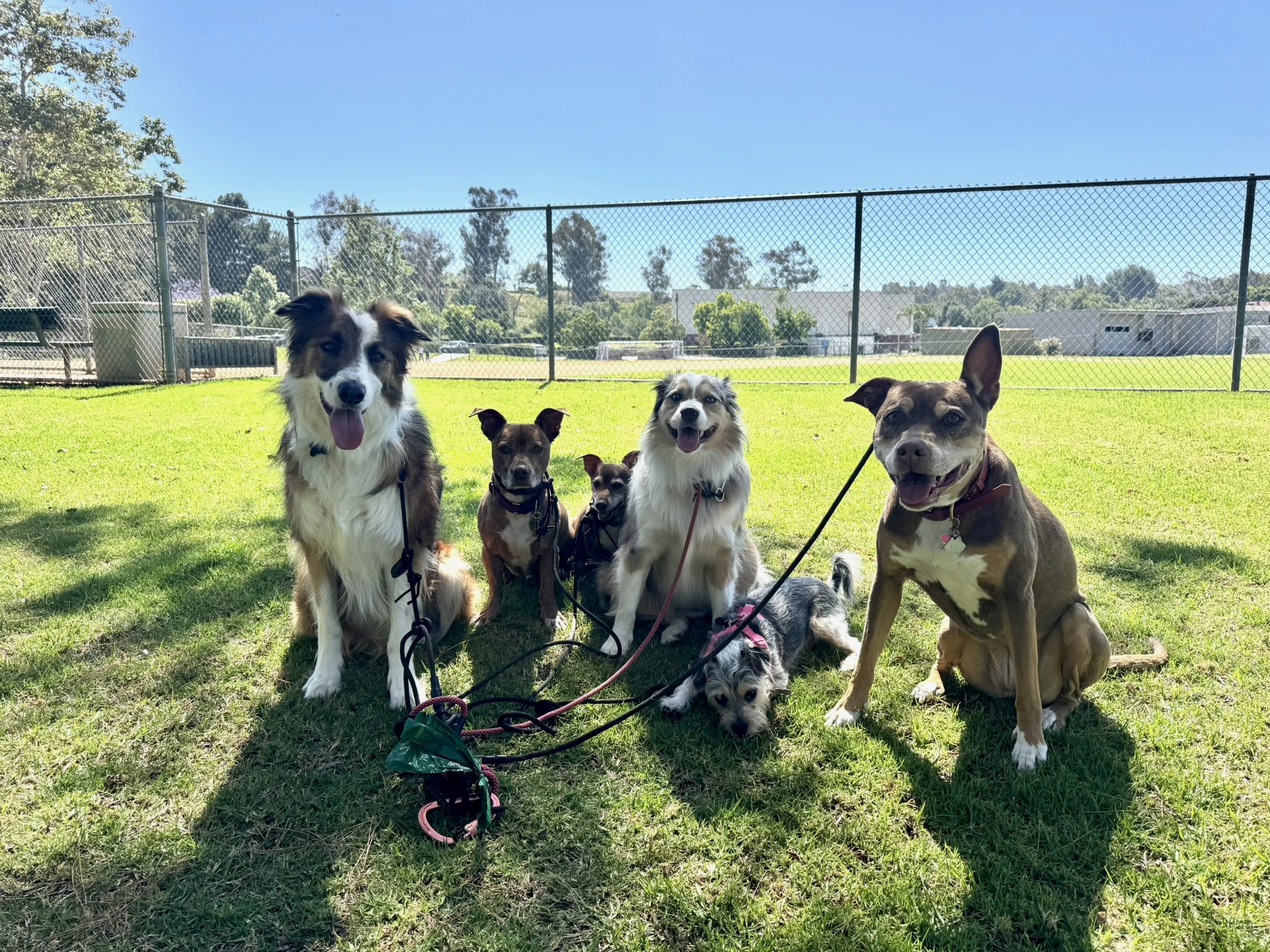
Small pack sizes allow each dog to receive personalized attention and comfortable socialization during group walks.
Stages of joining a Pack Walk
In-home assessment. A certified Pack Leader visits the dog at home. The visit covers temperament observation, leash behavior, and how the dog responds to novelty in familiar space. This isn't a pass or fail visit. It's a placement read.
Pack matching. Based on the assessment, the Pack Leader identifies which existing pack matches the dog's profile. Energy level, social tolerance, age range, and breed predispositions all factor in.
First walk, solo or paired. Most new dogs aren't dropped into a full pack of 8 on day one. The first walk is often one-on-one with the Pack Leader, or with a single calm peer dog the Pack Leader knows will set the right tone.
Full pack integration. When the assessment and first walk show the dog is ready, the Pack Leader brings the dog into the matched pack at the next available slot. Same Pack Leader, same composition, weekly.
What happens when a pack composition stops working
Pack composition is not permanent. Dogs change. A puppy who joined a calm senior pack at 8 months stops fitting at 14 months. A reactive dog who started in a small pack of 5 graduates to a regular pack of 7 once stable. A senior who slowed mid-year drops to a shorter route or moves to Private Walks for a stretch.
The certified Pack Leader watches for those shifts. When a dog's profile changes, the Pack Leader either re-matches the dog to a different pack or recommends a service change. The post-walk report card flags early signals before they become problems.
From group chaos to group structure
Orange County has plenty of group walks for hire. Most of them aren't pack walks. They're group walks where size, composition, and structure are negotiable based on whoever signed up that week. Pup Scouts holds the cap at 5 to 8 because that's where structured behavior change happens. Above it, you get exercise. Below it, you get a private walk wearing a different name.
If you're choosing between hiring a generic group walker for your Newport Beach or Irvine dog and joining a structured Pack Walk through Pup Scouts in Orange County, pack size is one of the cleanest questions to ask before you commit.
Frequently Asked Questions
What if my dog is shy or under-socialized? Will pack walking still work?
Yes, with the right pack. Pup Scouts evaluates every dog at an in-home assessment before any pack assignment. Shy dogs get placed in calm-dominant packs with experienced peer dogs, often in a smaller pack of 5 or 6 to start. Most shy dogs see noticeable confidence shifts within 4 to 6 weeks of consistent pack walks.
Can two dogs from the same household join the same pack?
Sometimes. It depends on whether the dogs have similar temperaments and energy levels. Two littermates with matched energy can often share a pack. A high-energy young Lab and a senior Shih Tzu from the same family usually need different packs, even if it's the same household. The match decision is based on each dog's profile, not their address.
How does Pup Scouts handle a new dog joining an existing pack?
The new dog usually starts with a one-on-one walk with the certified Pack Leader, or with a single calm peer dog. Once that calibration walk goes well, the new dog joins the matched pack at the next opening. The existing pack doesn't get disrupted. The new dog gets eased in.
What if my dog's behavior changes mid-year?
Pack composition is not set forever. If a dog's profile shifts after a move, after a medical change, or after a stressful event, the Pack Leader re-evaluates and may suggest moving to a different pack or stepping down to Private Walks for a stretch. Behavior changes are normal. The structure adapts.
Why doesn't Pup Scouts run bigger packs to fit more dogs per outing?
Because attention fragments above 8 dogs. The certified Pack Leader's job is to read every dog in real time. With 12 dogs, that's not possible. Some dogs become invisible. Behavior issues compound before they get caught. The 8-dog cap is the upper limit of what one Pack Leader can hold without losing structure for the dogs that need it most.
Written by Mike and Colleen Bass, founders of Pup Scouts. Mike and Colleen have led structured dog care across Maryland, Orange County, and Charlotte since 2015. More about our team.
Get started with OC Pup Scouts, or call (949) 629-0932. Find us on Google as OC Pup Scouts.
Similar Blogs


