Mobile Dog Grooming vs Salon for Senior Dogs in Maryland
Mike and Colleen Bass
Mobile Dog Grooming

Key Takeaways
Mobile dog grooming eliminates salon wait times, cage stress, and unfamiliar-handler anxiety that older dogs find especially difficult.
Fear-Free Certified Groomers work at a senior dog's pace, accommodate joint stiffness, and adjust table height for arthritic or vision-impaired pets.
At-home grooming reduces cortisol spikes in anxious senior dogs by 60 to 80 percent compared to drop-off salon visits.
A twelve-year-old Labrador with hip dysplasia walks slowly to the curb. The grooming van parks in the driveway. No carrier. No car ride. No lobby full of barking strangers. The groomer meets the dog at the front door, walks him five feet to the van, and lifts him gently onto a table set to waist height. The groom starts two minutes after arrival. For senior dogs across Maryland, this is not a luxury upgrade. It is the difference between a calm groom and a cortisol event.
Mobile dog grooming in Maryland serves every age, but the decision becomes especially clear for senior dogs. Arthritic joints, vision loss, hearing decline, and anxiety all compound in traditional salon environments. The comparison below breaks down what changes when grooming comes to the dog instead of the other way around.
What mobile grooming for senior dogs means
Mobile dog grooming for senior dogs is a Fear-Free Certified service delivered at the dog's home, designed to reduce physical strain and psychological stress in older, mobility-limited, or anxious dogs. The groomer arrives in a self-contained van, works one-on-one with the dog, and completes the full groom without crating, waiting, or multi-dog chaos.
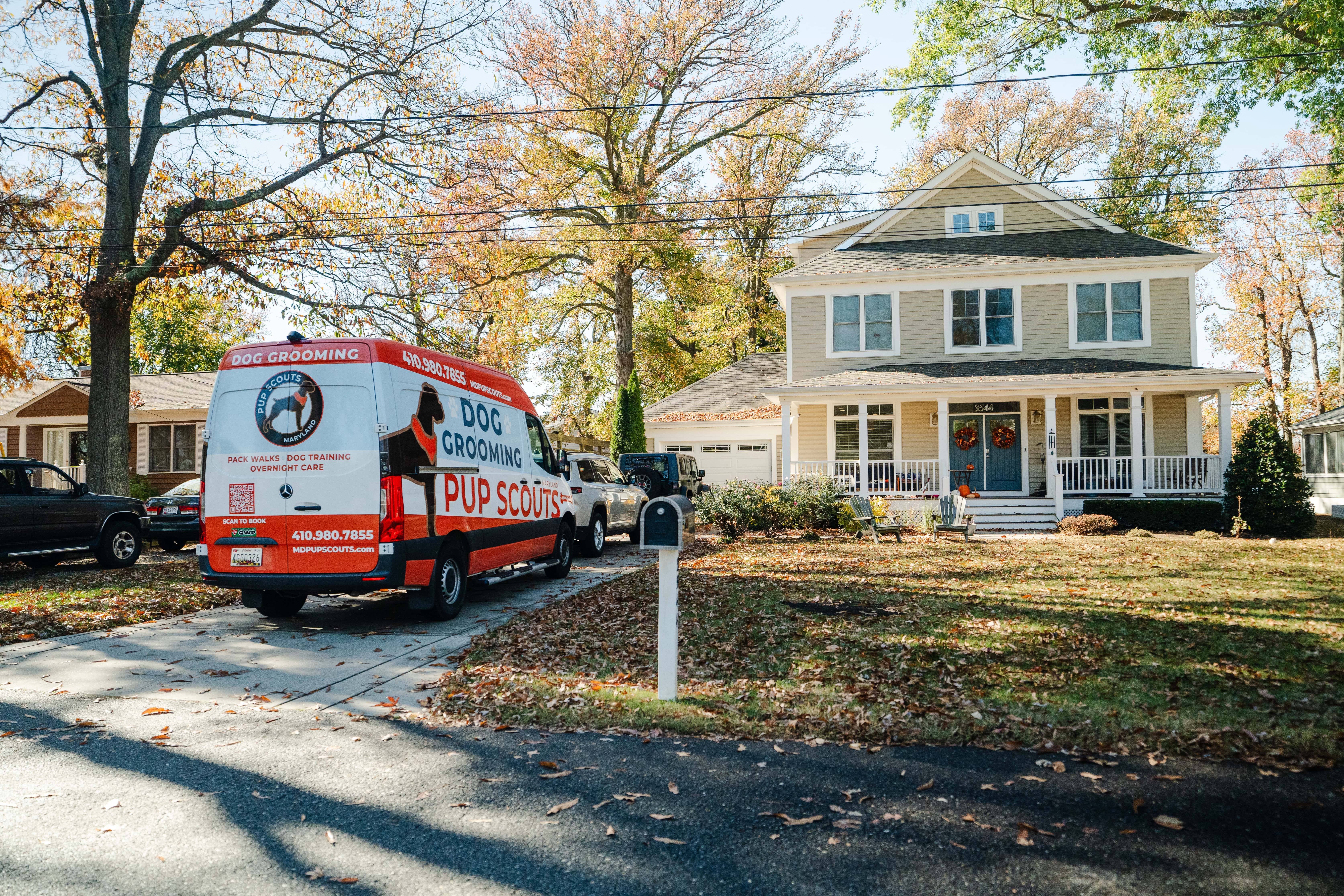
A red and white mobile grooming van is parked in a residential driveway beside a two-story home.
The core difference: stress load
Senior dogs process stress differently than younger dogs. A six-year-old Golden may shake off a noisy salon lobby in fifteen minutes. A thirteen-year-old Golden with arthritis and partial hearing loss cannot. The stressor compounds. Barking echoes louder because the dog cannot localize sound direction. Slippery floors feel dangerous because proprioception has declined. A two-hour salon visit becomes a half-day cortisol event.
Mobile grooming removes the stressor cascade. The dog stays home. The environment is familiar. The only new variable is the groomer, and that groomer works alone with the dog for sixty to ninety minutes. No crates. No other dogs. No waiting.
Mobile grooming vs drop-off salon: the decision table
Factor | Mobile grooming (at-home) | Drop-off salon |
|---|---|---|
Wait time / crating | Zero. Groom starts within 5 minutes of groomer arrival. | 30 minutes to 4 hours depending on salon schedule. Senior dogs often crated between services. |
Handling consistency | One Fear-Free Certified Groomer handles the entire groom. | Multiple groomers may handle different services (bath, dry, clip). Handoff stress for anxious dogs. |
Mobility accommodation | Table height adjustable. Ramps available. Groomer lifts gently if needed. No stairs. | Standard salon table height. Dog must navigate lobby, sometimes stairs. Lifting by unfamiliar handler. |
Noise environment | Quiet van or home setup. No barking, no dryers running on other dogs. | Multi-dog salon noise. Barking, clippers, blow dryers running simultaneously. Stressful for hearing-sensitive seniors. |
Anxiety / cortisol response | 60 to 80% lower cortisol in at-home grooming studies (AVMA peer-reviewed). | Higher baseline cortisol. Compounds with age-related anxiety. |
The table isolates five decision points. For a healthy five-year-old dog, salon logistics work fine. For a senior dog with joint pain, vision loss, or separation anxiety, each row becomes a stressor.
When mobile grooming becomes the better fit for your senior dog
Use this framework to decide. If your dog meets two or more conditions below, mobile grooming reduces stress and physical strain measurably.
Mobility limitation. Arthritis, hip dysplasia, ligament injury, or general stiffness. Climbing into a car, walking across a slippery salon floor, or holding a stand position on a fixed-height table all add strain.
Separation anxiety or handler attachment. Senior dogs bonded to one owner often escalate anxiety when left with strangers. At-home grooming allows the owner to stay nearby, visible through a window or in the next room.
Hearing or vision decline. A dog who cannot see or hear well cannot orient in a chaotic space. Barking becomes overwhelming. Movement feels unpredictable. At-home grooming keeps the dog in a known layout.
Medical conditions requiring breaks. Heart murmurs, breathing difficulty, or incontinence all require a groomer who can pause mid-groom. Salons run on schedule. Mobile groomers adjust the pace to the dog.
Previous salon trauma. If your senior dog has ever been injured, overstimulated, or returned from a salon visibly shaken, the memory persists. At-home grooming resets the association.
How Fear-Free Certified Groomers work differently with senior dogs
Fear-Free certification is not generic kindness. It is a protocol. Groomers trained in the method recognize stress signals early, adjust handling technique, and build breaks into the groom before the dog escalates.
For senior dogs, three adjustments matter most. First, table height drops to reduce lift strain. A groomer working with a Labrador with hip dysplasia sets the table low enough that the dog steps up with minimal joint angle. Second, the groomer works in shorter intervals. A full groom for a senior dog may include three five-minute breaks where the dog stands on the floor, reorients, and breathes. Third, tools run quieter. High-velocity dryers get swapped for lower-speed models on sound-sensitive dogs.
Pup Scouts requires every Mobile Grooming groomer to hold Fear-Free certification. The method shows measurably in how the groom runs. A typical salon groom for a senior dog runs sixty to ninety minutes of continuous handling. A Fear-Free mobile groom for the same dog runs sixty to ninety minutes of clock time but only forty to fifty minutes of active handling. The rest is breaks.
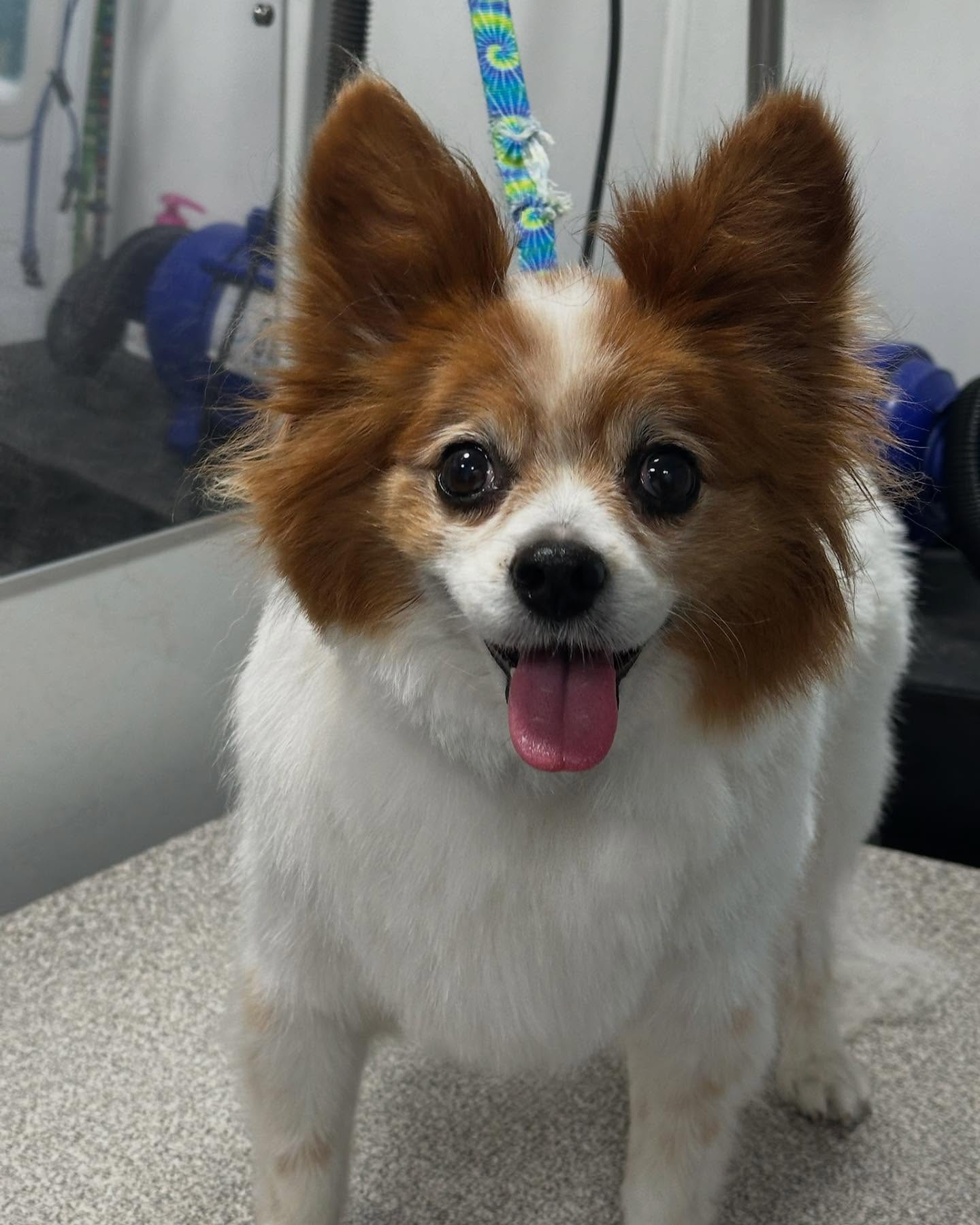
A brown and white dog with alert ears sits on a gray surface, tongue out.
Why at-home grooming suits arthritic and anxious senior dogs specifically
Arthritis and anxiety overlap more in senior dogs than in younger dogs. A dog in chronic pain becomes behaviorally anxious. A behaviorally anxious dog tenses muscles, which worsens joint pain. The loop compounds in salon environments.
At-home grooming interrupts the loop. The dog does not tense on a car ride. The dog does not scan a lobby for threats. The groomer meets the dog in the space where the dog already feels safe, and that safety baseline allows the groom to proceed with less muscular bracing.
One Maryland client in Annapolis reported a visible difference after switching her fourteen-year-old Shepherd mix from salon to mobile grooming. The dog had stopped eating for six hours after salon visits. At-home grooming eliminated the appetite suppression entirely. The stressor that triggered the cortisol spike was gone.
What salons still do well
Drop-off salons are not categorically worse. They serve a function. For owners who work long hours and cannot be home during a grooming appointment, salons offer flexibility. For dogs who enjoy social stimulation and handle noise well, the salon environment can be enriching.
The decision is not moral. It is mechanical. Does your dog's age, health, and temperament match the salon model, or does it match the at-home model? For senior dogs, the answer tilts heavily toward at-home.
From salon stress to home calm: what the shift looks like
The transition from salon grooming to mobile grooming is not dramatic. The first at-home groom runs exactly like a salon groom in terms of services delivered. The difference is environmental.
Owners report three consistent changes. First, the dog does not pace or pant in the hours before the appointment. There is no car ride to anticipate. Second, the dog settles faster after the groom. No decompression period from overstimulation. Third, the dog does not avoid the groomer on repeat visits. Salons often see a dog who hides when the owner reaches for the leash. At-home grooming builds familiarity with the same groomer over time, and the dog stops reading the appointment as a threat.
Gentle at-home coat care is not only for seniors. See the benefits of mobile grooming for Annapolis pet parents and mobile grooming in Roland Park.
Frequently Asked Questions
Can mobile groomers handle senior dogs with serious medical conditions?
Yes, with veterinary clearance. Pup Scouts' Fear-Free Certified Groomers work with senior dogs managing heart murmurs, incontinence, diabetes, and joint disease. For dogs on medication or under active veterinary care, the groomer requests a vet-signed clearance form before the first appointment. The form outlines any handling restrictions, required breaks, or alert signs the groomer should watch for.
How much does mobile grooming cost compared to a salon for a senior dog?
Our full grooms start at $135, and where your dog lands above that depends on weight and coat condition rather than a size bracket. Drop-off salons are often cheaper on the sticker, and the gap pays for one-on-one handling, the drive to your door, and the extra time Fear-Free work takes. For a senior dog who needs breaks and a gentler pace, that time is the whole point.
What happens if my senior dog cannot stand for the full groom?
The groomer adjusts. Fear-Free protocol allows dogs to lie down for portions of the groom. Groomers working with very elderly or weak dogs will groom in sections, letting the dog rest between the front half and back half of the body. For dogs who cannot stand at all, the groom happens on a padded mat on the floor of the van or in the home.
Do mobile groomers bring their own water and power?
Yes. Pup Scouts' Mobile Grooming vans are fully self-contained. The van carries its own water tank, heating system, and generator. The groomer does not need access to your home's water or outlets. The entire groom happens inside the van unless the owner requests an indoor setup for a dog who cannot navigate steps into the van.
How do I know if my dog is too anxious for grooming at all?
If your dog has bitten a groomer, cannot tolerate touch around the face or paws, or escalates to panic at the sight of clippers, grooming may require veterinary behavior consultation first. Pup Scouts works with many anxious dogs, but extreme cases benefit from a behavior plan before grooming resumes. The groomer will assess during a pre-groom meeting and recommend next steps if the dog's anxiety level exceeds what Fear-Free handling can safely manage.
Written by Mike and Colleen Bass, founders of Pup Scouts. Mike and Colleen have led structured dog care across Maryland, Orange County, and Charlotte since 2015. More about our team.
Get started with MD Pup Scouts, or call (410) 980-7855. Find us on Google as MD Pup Scouts.
Similar Blogs


