Dog Walking in Federal Hill for Reactive Dogs
Mike and Colleen Bass
Pack Walking

Key Takeaways
Federal Hill's narrow row-house sidewalks, busy weekend foot traffic, and constant proximity to other dogs make it one of the harder Baltimore neighborhoods for reactive dogs to navigate without structured support.
Pup Scouts builds Pack Walks for reactive Federal Hill dogs around three controls: a smaller pack of 5 to 6 calm peers, a route the dog has walked successfully before, and a certified Pack Leader who reads escalation signals before they compound.
Most reactive Federal Hill dogs see noticeable behavior shifts by week 4 of consistent weekly Pack Walks. Shifts compound when the same Pack Leader runs the same pack on the same day each week.
Federal Hill is harder on reactive dogs than its prettier blocks suggest. The sidewalks are narrow. The row-house front stoops put strangers within five feet of every passing dog. Cross Street Market crowds spill onto Light Street. Park-bound traffic stacks at corners. For a reactive dog, every block has at least one trigger built into the geography, and most of them aren't avoidable on a daily walk. The dog learns to predict the threat. The leash tightens. The walk becomes work.
Dog walking in Federal Hill for reactive dogs has to account for that geography rather than fight it. Pup Scouts' Pack Walking Adventures in this part of Baltimore are built around three controls: who the dog walks with, where the route goes, and how the certified Pack Leader paces the exposure. Federal Hill reactivity rarely improves through avoidance. It improves through structured exposure with peer support and a handler reading every signal in real time.
What "reactive" usually means here
Reactivity covers a wide range of dog behavior. For most Federal Hill families using Pack Walks, "reactive" means a dog who escalates around stimuli the neighborhood produces in volume: other dogs at a distance, runners turning a corner, kids on scooters, sudden noises from Light Street patios. The dog isn't aggressive. The dog is over-aroused, and the Federal Hill streetscape produces over-arousal on every block. The Pack Walk's job is to teach the dog that those stimuli can pass without escalation.
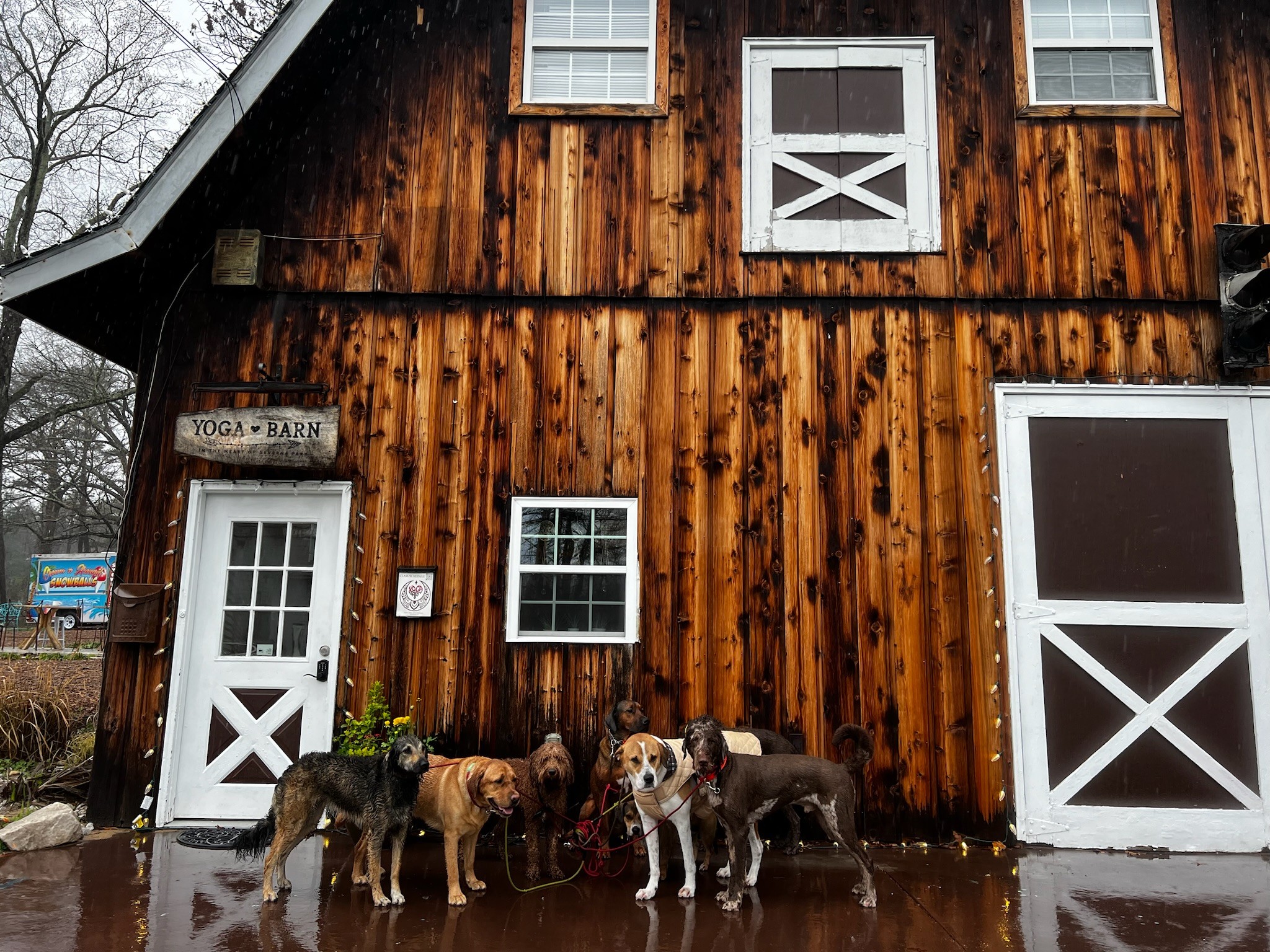
Structured pack walks help reactive dogs build confidence through positive group experiences and guided leadership.
Why pack walks work for reactive Federal Hill dogs
Reactive dogs often improve faster on a structured Pack Walk than on solo walks, even though intuition says the opposite. The reason is peer learning.
A reactive dog walking solo with their owner sees every passing stimulus as their problem to solve. Their reaction is the only available response. On a Pack Walk with five calm matched peers, the same dog watches four other dogs handle the same stimulus calmly. The peer dogs become a real-time demonstration of an alternative behavior. The reactive dog's options widen.
That's the dynamic the certified Pack Leader is staging. The pack composition is the lesson. The route is the controlled environment. The Pack Leader reads when to add distance, when to pause, when to redirect. None of those moves work without the right peer dogs in the pack.
How is a Federal Hill pack different from other Baltimore packs?
Federal Hill packs typically run smaller than the standard 5-to-8 cap. For reactive-recovering dogs, Pup Scouts often holds Federal Hill packs at 5 or 6, not 7 or 8. Smaller packs let the certified Pack Leader give a reactive dog more buffer when a tight sidewalk forces a closer pass than usual.
Routes in Federal Hill tend to favor the quieter side streets (Battery, Hamburg, Warren) over the busier Light Street and Cross Street stretches, especially during the first month. As the reactive dog stabilizes, the Pack Leader adds gradual exposure to the busier corridors. The progression is paced by the dog, not by a route schedule.
Pack Walk fit by reactive-dog profile
Reactive profile | Pack Walks fit | Recommended starting point |
|---|---|---|
Distance-reactive (escalates from 30+ feet) | Excellent fit. Distance is easy to manage on Federal Hill side streets. | Explorer Hour, pack of 5 calm peers |
Close-trigger reactive (escalates within 10 feet) | Good fit with the right pack. | Explorer Hour, pack of 5, route favoring wider streets |
Reactive to specific dog types (e.g., other Labs, small dogs) | Manageable through pack composition. | Explorer Hour, pack matched to avoid the trigger profile |
Reactive after a recent incident | Wait for stabilization first. | Private Walks for 2 to 4 weeks, then assess |
Aggressive (not reactive) | Not a fit. | Dog Training before any pack |
The match decision happens during the in-home assessment. Pup Scouts will not place a dog in a Federal Hill pack if the assessment shows the dog needs Private Walks or Dog Training first. The pack is for dogs who can succeed in it.
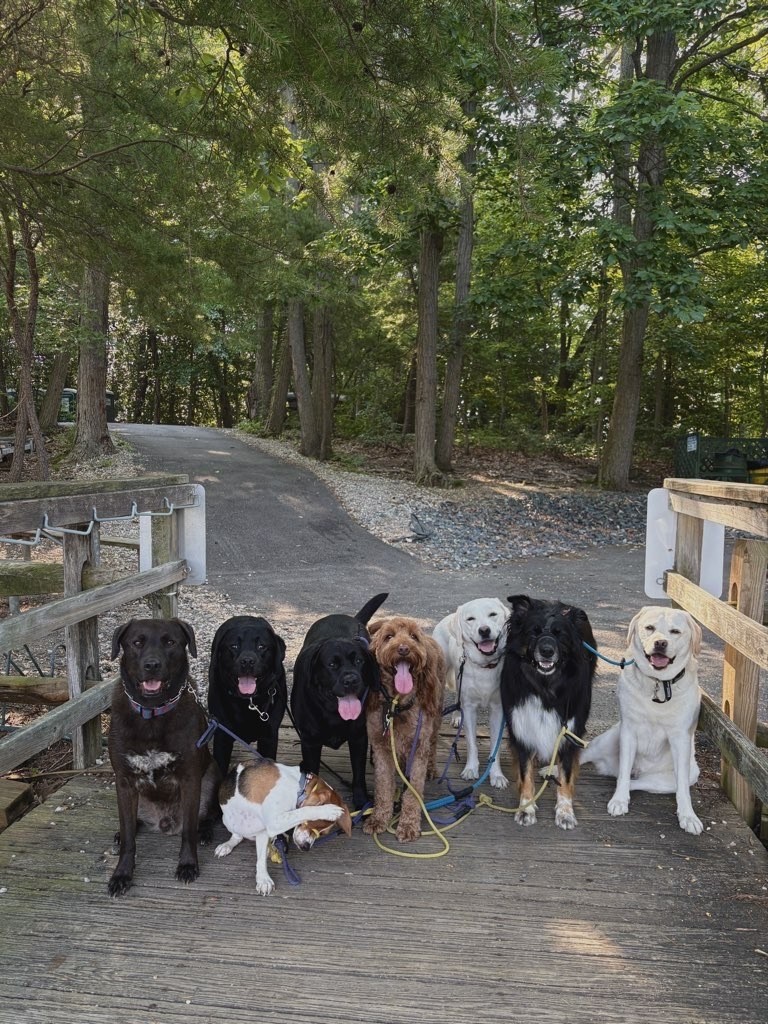
A diverse pack demonstrates the confidence and calm that structured group walks help dogs develop over time.
What the first month looks like for a reactive Federal Hill dog
Week 1: in-home assessment and first calibration walk. A certified Pack Leader visits the dog at home, observes leash behavior in familiar space, and runs a brief solo walk through a quiet stretch of Federal Hill. No pack yet. The walk is data.
Week 2: paired walk with one calm peer dog. The Pack Leader brings the dog and one experienced calm peer on a quiet route. The new dog watches the peer handle a few low-grade stimuli. Distance is generous. The walk is short.
Week 3: small pack entry. The dog joins a pack of 5 calm matched peers on a familiar route. The Pack Leader holds extra buffer when passing close-quarter stimuli. The dog gets to be one of five, not the only one solving the problem.
Week 4: standard pack rhythm. The dog runs in the same pack on the same day with the same Pack Leader. The route stays familiar. Stimulus exposure increases gradually within what the dog can handle. Most reactive dogs by this point have a noticeably shorter recovery time after a trigger.
Week 5 onward: progression decisions. The Pack Leader and family decide together whether to extend to the 4-hour Scout Expedition, expand the route to busier corridors, or hold steady at the current Explorer Hour rhythm. Some Federal Hill dogs stay at the Explorer Hour level long-term and that's fine.
This is one progression pattern, not a fixed schedule. Some reactive dogs move faster. Some need a slower week 2 or a repeat of the calibration walk. The structure adapts to the dog.
What changes for the family
Reactive Federal Hill dogs put a daily tax on their families. Walks get planned around stimulus avoidance. Errands take longer. The dog's exercise needs and the family's nervous-system needs end up at odds. Pack Walks shift that load.
The post-walk report card lets the family see what the dog handled that day, where the pack was, what triggers came up, and how the dog recovered. Over a few weeks, the report card becomes a record of progress the family can point to when wondering whether the work is paying off. Most weeks, it is.
From neighborhood threat to neighborhood routine
Federal Hill doesn't get easier. The sidewalks stay narrow. The runners stay frequent. The market crowds stay loud. What changes is the dog. After a few months of structured Pack Walks, most reactive Federal Hill dogs walk past stimuli they used to escalate at, with the same neighborhood unchanged around them.
That's the goal. The neighborhood didn't stop being challenging. The dog learned to walk through challenging without losing composure.
Frequently Asked Questions
How do I know if my Federal Hill dog is reactive enough to need a structured Pack Walk versus a regular dog walker?
If your daily walks include leash management to avoid triggers, route planning around stimulus density, or a sense that the walk is more work than pleasure, your dog is in the territory where a structured Pack Walk usually outperforms a regular dog walker. Pup Scouts assesses every dog at an in-home visit before recommending a service.
Can my reactive Federal Hill dog actually walk alongside other dogs?
Yes, when the pack is matched correctly. The peer dogs in a reactive-friendly Federal Hill pack are calm, experienced, and screened by the certified Pack Leader. Reactivity is not the same as dog aggression. Most reactive dogs do well with calm peers; what they struggle with is unstructured stimulus.
What if my dog has a setback during a Pack Walk?
Setbacks are normal in reactive-dog work. The certified Pack Leader notes the trigger, the response, and the recovery time on the post-walk report card. If a setback is part of a pattern (rather than a one-off), the Pack Leader recommends adjusting the pack, the route, or stepping briefly to Private Walks for stabilization. Setbacks aren't failures. They're data.
Will my Federal Hill dog ever be ready for the busier corridors like Light Street?
Many reactive Federal Hill dogs eventually walk through Light Street and Cross Street stretches calmly. The path there is gradual. Pack Walks build the foundation. Some dogs reach that level by month 3. Some take longer. Some never do, and that's fine. The goal is a dog who handles their daily reality, not a dog who passes a specific test.
Is dog training a better option than pack walking for a reactive dog?
Sometimes both. For dogs whose reactivity has not stabilized recently, Dog Training in Maryland often runs alongside Pack Walks, with training building the response skills and pack walks building the real-world confidence. The in-home assessment determines which combination fits the dog.
Written by Mike and Colleen Bass, founders of Pup Scouts. Mike and Colleen have led structured dog care across Maryland, Orange County, and Charlotte since 2015. More about our team.
Get started with MD Pup Scouts, or call (410) 980-7855. Find us on Google as MD Pup Scouts.
Similar Blogs


