How Often Should You Walk Your Dog?
Mike and Colleen Bass
Pack Walking

Key takeaways
Most adult dogs need walking twice a day. Frequency matters more than total distance for toileting, joints and settling.
Working breeds need two to three outings. Flat-faced breeds need shorter, cooler ones. Senior dogs need more frequent and shorter, not fewer and longer.
If your dog comes home wired rather than tired, the answer is a different walk rather than a longer one. If you've ever come back from a long walk with a dog who's somehow more wound up than when you left, you're not imagining it, and you're definitely not alone. Most dogs should be walked twice a day, and frequency is the part that matters. Two thirty minute walks do more for your dog's toileting, joints and ability to settle than one sixty minute walk, and they break up a day your dog would otherwise spend waiting by the door.
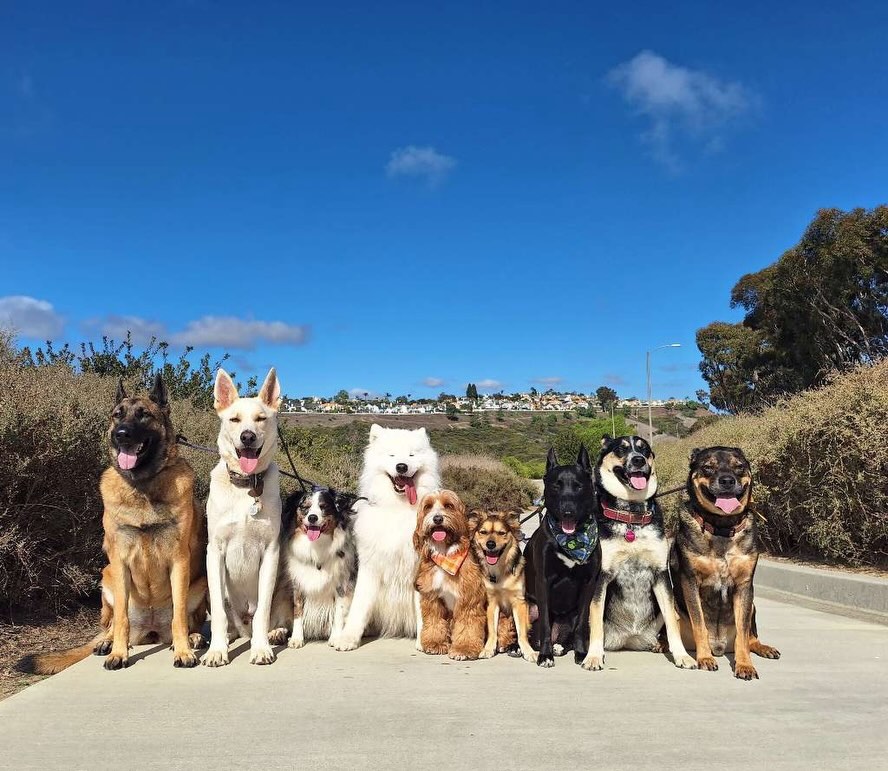
Nine dogs of varying sizes sit together on a paved path lined with dry brush and coastal landscape.
By age and build
Dog | Times a day | Roughly |
|---|---|---|
Puppy | 2 short outings | 5 minutes per month of age, each |
Small adult, low energy | 2 | 15 to 20 minutes each |
Medium adult | 2 | 20 to 30 minutes each |
Working breed | 2 to 3 | 30 to 45 minutes each |
Flat-faced breed | 2 short, cool hours only | 10 to 20 minutes each |
Senior | 2 to 3 short | 10 to 20 minutes each |
The puppy rule is there to protect growth plates that haven't closed yet. Five minutes per month of age, twice a day. We know it feels like nowhere near enough, and it's still the right number.
Why twice beats once
Three reasons, and none of them is really about exercise.
Toileting. A dog asked to hold it for twelve hours is uncomfortable long before it becomes a problem, and in some dogs that habit of holding turns into urinary trouble.
Joints. Two moderate outings are much easier on an arthritic dog than one long one. If your dog is stiff the next morning, yesterday was too much in one go.
Settling. A dog with one event in the day spends the whole day waiting for it. A dog with two has a rhythm, and rhythm is what gives you a dog who sleeps through the afternoon instead of pacing the hallway.
When more walking is the wrong answer
If your dog comes home from a long walk more wound up than it left, adding minutes is going to make it worse.
A dog that spends its walk pulling, scanning and reacting has had an hour of arousal rather than an hour of exercise. Their nervous system doesn't really distinguish between excitement and stress, so your dog gets home with both still running. That's why you can walk for an hour and still have a dog who can't lie down.
What helps is a different walk, not a longer one. Slower pace, quieter route, more sniffing, deliberate distance from other dogs. A dog that walks calmly for twenty minutes is more tired than a dog who hauled you around for an hour.
Three cases where shorter and calmer beats longer:
The reactive dog. More time out means more triggers, and more practice at reacting.
The anxious dog. Some dogs endure walks rather than enjoy them, and the tell is a dog walking out ahead with a tight body and no interest in sniffing anything.
The senior dog with sore joints. Frequency beats duration every single time here.
Making a walk count
Leave calm. If your dog goes out the door already over threshold, you'll spend the first ten minutes bringing it back down.
Set the pace yourself. A steady rhythm settles a dog faster than a stop-start shuffle, and your dog will take the cue from you.
Build in sniffing on purpose. Scent work tires a dog out of all proportion to distance. Five minutes at a good hedge beats ten more on the sidewalk.
Pass other dogs at a distance that actually works, not the one you wish worked. Nobody's judging you for crossing the street.
End calm. The last two minutes are the ones your dog remembers.
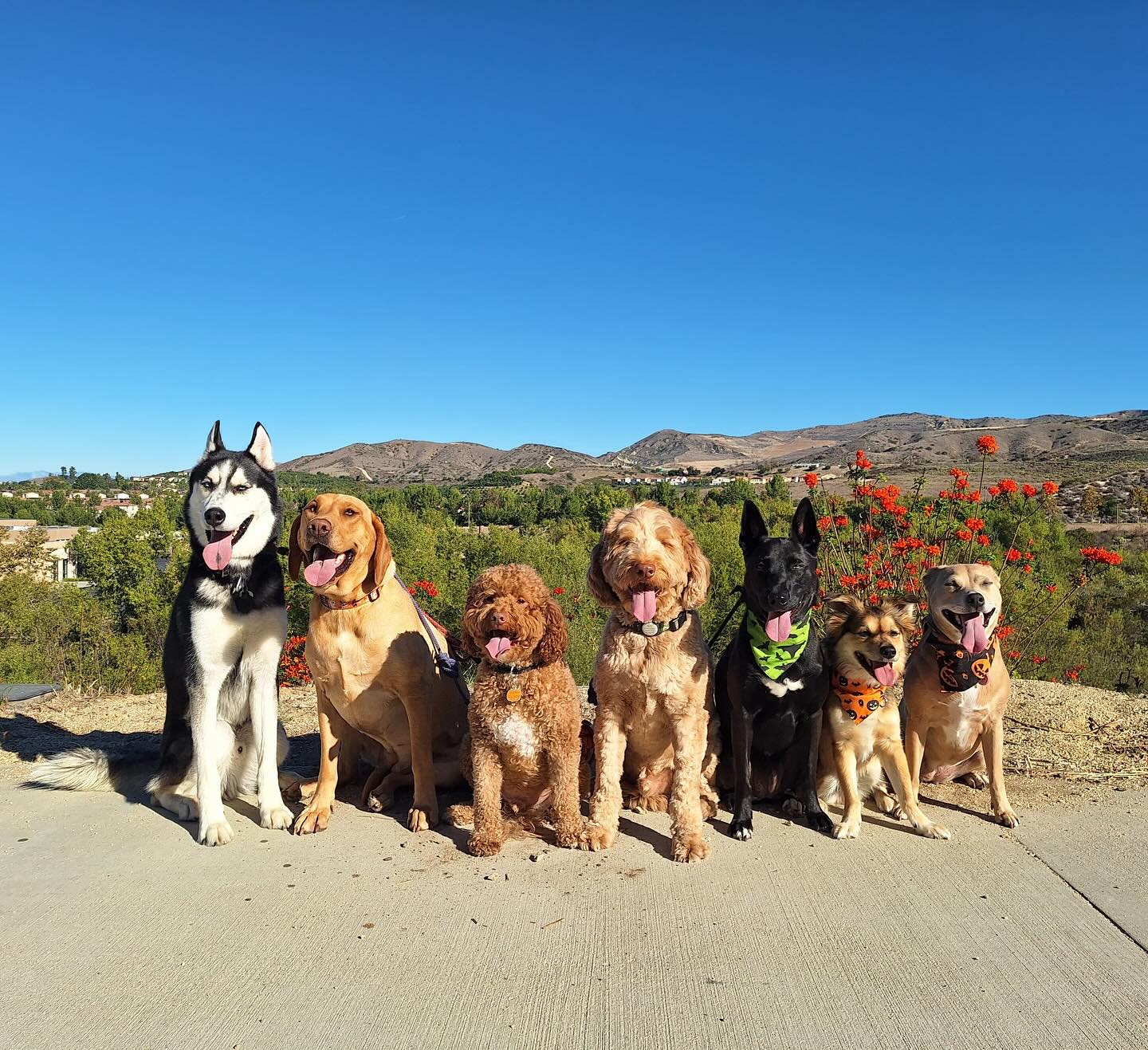
Seven dogs sit together on pavement with mountains and wildflowers visible in the background.
What a group walk adds
Once your dog is comfortable near other dogs, walking alongside them without being asked to greet them is a genuinely different experience from a solo walk. Your dog gets proximity without pressure, and for most dogs that's far more settling than a park.
Our pack walking in Costa Mesa runs five to eight temperament-matched dogs on leash with the same certified Pack Leader every week, so your dog is walking with familiar company rather than whoever showed up. We run two options and deliberately only two: the Explorer Hour is a 60 minute structured walk at $44 with pickup and drop off included, and Scout Expedition is a four hour outing at $66 a day for the dogs who need a good deal more than a walk.
Both are leashed structured walking the whole way through. The temperament matching is what makes a group work instead of just being a group.
If your dog isn't ready for company yet, that's completely fine and pretty common. Private dog walking means the route and the pace get built around your dog alone. We also cover pack walking across Orange County from Newport Beach south to San Clemente, and you can check availability on the OC Pup Scouts Google profile.
Frequently asked questions
How often should I walk my dog each day?
Twice a day for most adult dogs. Working breeds often need two to three outings, senior dogs do better on two or three short ones, and puppies get five minutes per month of age, twice a day.
Is one long walk enough for a dog?
Usually not. Two shorter walks do more for toileting, joints and settling, and they break up a day your dog would otherwise spend waiting on you.
How long should each walk be?
Twenty to thirty minutes for a medium adult dog, thirty to forty-five for a working breed, and ten to twenty for a senior or a flat-faced breed.
Why is my dog still hyper after a long walk?
Because the walk was arousing rather than tiring. A dog that pulls and scans for an hour comes home with its nervous system still running. Slower, quieter and shorter will usually give you a calmer dog by dinner.
Can I skip a walk if my dog has a yard?
A yard covers toileting and not much else. What a walk gives your dog is novelty, scent and movement, and a familiar yard can't offer any of the three.
Written by
Mike and Colleen Bass. Mike and Colleen run Pup Scouts across Maryland, Orange County and Charlotte, and every Pack Leader is certified and background checked. Exercise guidance follows the American Kennel Club.
Book a walk in Orange County
If twice a day isn't happening on your schedule, that's exactly what we're here for, and we'd love to meet your dog. See pack walking in Costa Mesa.
Similar Blogs


