Dog Walking in Charlotte: Earning the First Walk
Mike and Colleen Bass
Pack Walking

Key Takeaways
The Discovery Visit is a structured in-home introduction that happens before any dog joins a Charlotte pack walk, no drop-offs, no trial runs.
We assess temperament, household routine, and walking goals during a 20 to 30 minute session your dog leads at their own pace.
Trust is earned in stages, first at the door, then in the home, then on leash, so the first group outing feels like a known routine, not a stranger event.
A front door opens in Myers Park. A dog, part Lab, part something else, watches from behind a baby gate. The Pack Leader waits. No commands. No rush. The dog decides when to approach. That moment, quiet and ordinary, is where Charlotte dog walking starts at Pup Scouts. Not on the route. Not in the pack. At the threshold.
Most dog walking services in Charlotte skip this step. They text a start date, show up with a leash, and expect the dog to follow. Some dogs do. Others bark through the window for twenty minutes, then spend the walk scanning for their person. At Pup Scouts, the first interaction isn't a walk, it's a Discovery Visit. A structured in-home introduction where the dog sets the pace, the handler observes, and trust gets built in stages before any group outing happens.
Every dog that joins Pack Walking Adventures in Charlotte goes through this process. It's not a sales call. It's not a behavioral assessment in the clinical sense. It's the moment we earn the right to that first walk.
What the Discovery Visit Is
The Discovery Visit is a 20 to 30 minute in-home session where a certified Pack Leader meets your dog in their own space, observes how they move through their routine, and discusses what walking in Charlotte looks like for your household. No clipboards. No pressure. The dog leads. We follow.
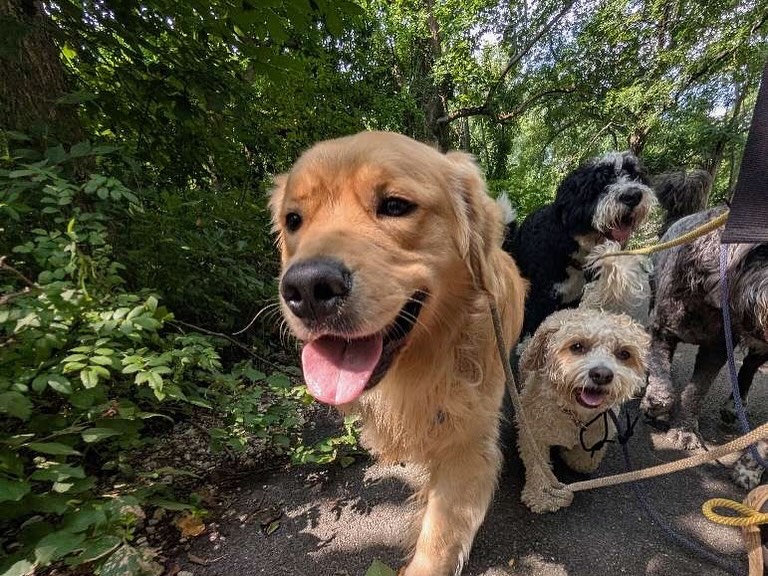
A golden retriever walks alongside three smaller dogs on a leafy, tree-covered path.
Why Charlotte Dogs Need This Step
Charlotte's residential density varies. SouthPark sits next to cul-de-sacs. Dilworth's sidewalks run tight to porches. Plaza Midwood has foot traffic most of the day. A dog comfortable in one setting can be overstimulated in another. The Discovery Visit lets us see how your dog handles transitions, new people, and spatial pressure before we introduce the variables of a group walk.
It also resets expectations. Some owners assume their dog will love a pack immediately. Others assume their dog will hate it. Both are guesses. The visit gives us data, how the dog greets at the door, whether they check in during the walkthrough, how long it takes them to settle when a stranger is present. That shapes the onboarding plan.
The Four Stages of Building Trust
The Discovery Visit isn't one long conversation. It unfolds in four deliberate stages, each one a checkpoint the dog controls.
Stage 1: Threshold Assessment
We meet at the door. The dog is on the other side, behind a gate, in a crate, or loose in the entry depending on household setup. The Pack Leader doesn't knock and walk in. They wait for the owner to open the door, then pause. If the dog barks, we let them. If they retreat, we give them space. If they approach, we let them sniff without reaching down.
This stage answers one question: does this dog view strangers as threats, puzzles, or part of the routine? The answer tells us whether the first pack walk needs a solo intro walk first, or whether they're ready for a small group right away.
Stage 2: Home Walkthrough
Once the dog allows proximity, we move into the home. Not to every room, just the main living area and the route to the door the dog uses for walks. The Pack Leader watches how the dog navigates their own space when a new person is present. Do they shadow the owner? Do they check in with the Pack Leader? Do they ignore both and go about their routine?
We also ask about the current walking setup. What time do walks happen? What door do you use? Does the dog pull when the leash comes out, or do they wait? These aren't judgment questions, they're logistical. If your dog gets overstimulated by the leash itself, we need to know that before adding four other dogs to the equation.
Stage 3: Leash Introduction
If the dog is calm enough, we clip a leash and take three steps. Not a lap around the block, three steps from the door into the yard or down the driveway. The goal isn't to walk them. It's to see how they respond to a new handler holding the leash in their own space, where everything else is familiar.
Some dogs treat it like any other walk. Some freeze. Some pull toward the owner. All three responses are useful. They tell us whether this dog is ready for a group setting, or whether they need one or two solo outings with the same Pack Leader first to build that handler-dog bond before the pack is introduced.
Stage 4: Route and Schedule Planning
The final stage is the conversation. We discuss your dog's energy level, any known triggers (skateboards, other dogs on leash, delivery trucks), and what a typical Charlotte dog walking route for their temperament group would look like. For a high-energy dog in SouthPark, that might mean Freedom Park's longer loops. For a sensitive dog in Dilworth, that might mean residential streets with predictable rhythms and fewer surprises.
We also confirm scheduling. Pup Scouts runs morning and midday pack walks across Charlotte. The Discovery Visit helps us match your dog to the right time slot and the right group, not just by energy, but by routine. A dog used to 7am outings won't settle into an 11am slot without friction.
What Happens After the Visit
Most dogs are cleared to join a pack walk within the week. A few need one solo walk first with the Pack Leader who conducted the Discovery Visit, not because they failed anything, but because the staged approach works better for their temperament. Solo walk, then duo walk, then small pack. It's the same progression a good handler uses at a dog park, except formalized.
Once the dog joins the pack, the same Pack Leader handles them week over week. Pup Scouts doesn't rotate walkers. Consistency isn't a perk, it's the system. The dog already knows the handler from the Discovery Visit. They already know the route pattern. The first group walk becomes the next predictable step, not a reintroduction.
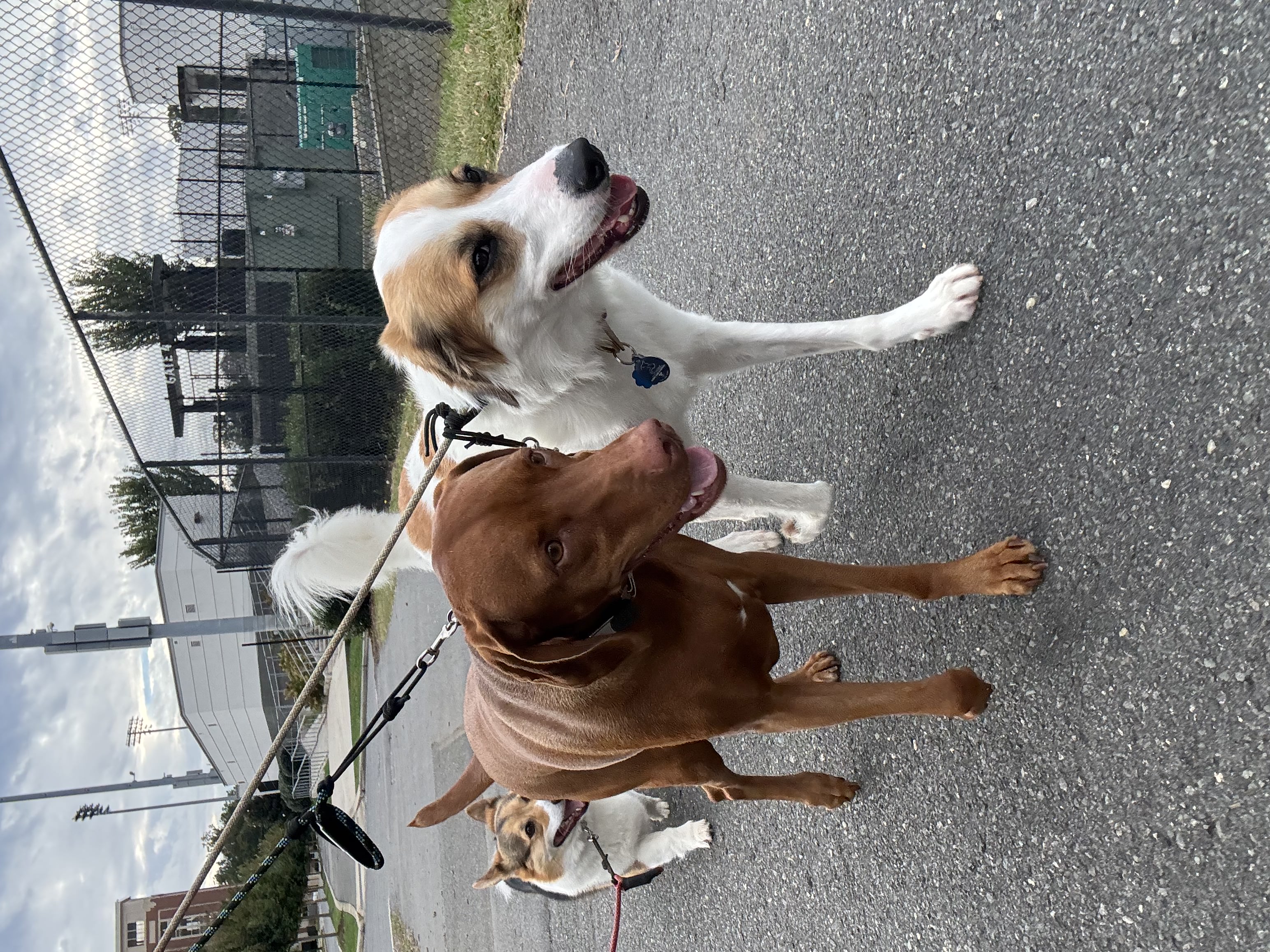
Three dogs walk together on a paved surface during a pack walking adventure.
Why We Don't Skip This
Some services onboard over the phone. Others do a "trial walk" where the dog meets the pack cold. Both approaches work for some dogs. They don't work for the dogs Pup Scouts serves, the ones whose owners chose structured care specifically because their dog doesn't do well with variables.
The Discovery Visit removes the biggest variable: the handler. By the time your dog joins a Charlotte pack walk, they've already decided the person holding the leash is safe. That's not something you can shortcut.
From Strangers to Known Routine
The difference between a dog that pulls toward home the entire walk and a dog that settles into stride isn't training in the traditional sense. It's familiarity. The Discovery Visit gives us one interaction in the dog's own space, under their conditions, before we ask them to perform in a group. That one session, 20 minutes, no pressure, dog-led, is why most Pup Scouts dogs treat their first pack walk like their fifth.
Comparison: Discovery Visit vs. Standard Onboarding
Approach | Where it happens | Who controls the pace | What gets assessed | Timeline to first walk |
|---|---|---|---|---|
Pup Scouts Discovery Visit | Your home | The dog | Temperament, routine fit, threshold behavior, handler rapport | 3 to 7 days (includes solo if needed) |
Phone-only onboarding | N/A | The owner | Schedule, address, payment | Same day or next day |
Trial walk | On the route | The walker | How the dog performs in group | Same day, dog meets pack cold |
Facility-based intro | Daycare or kennel | The facility | How the dog behaves in a controlled indoor environment | 1 to 2 days (may include evaluation fee) |
The Discovery Visit sits between phone onboarding (too little) and multi-day facility evals (too formal). It's enough structure to ensure safety and enough flexibility to let the dog show us who they are.
Frequently Asked Questions
Does the Discovery Visit cost extra?
No. It's part of the onboarding process for every dog that joins Pack Walking Adventures in Charlotte. You pay for the service once your dog starts regular walks, the Discovery Visit itself is included.
What if my dog doesn't warm up to the Pack Leader during the visit?
That's useful information. If your dog stays guarded or stressed after 20 minutes, we'll recommend starting with solo walks first, or we'll match them with a different Pack Leader whose energy better suits their temperament. The goal isn't to force a bond, it's to find the right fit.
Do you do Discovery Visits for services other than pack walks?
Yes. Private Walks, Mobile Grooming, and Overnight Boarding all include an in-home introduction before the first service. The structure varies slightly by service, but the principle stays the same, meet the dog in their space first, then move to the work.
How soon after the Discovery Visit does my dog start walking?
Most dogs join a pack within 3 to 7 days. If the visit shows your dog needs a solo walk first, we'll schedule that within the same window, then transition to the group once the handler rapport is established.
What neighborhoods in Charlotte do you serve for pack walks?
We operate across SouthPark, Myers Park, Dilworth, Plaza Midwood, and surrounding areas. The Discovery Visit helps us match your dog to a route and group that makes sense for your location and their temperament.
Written by Mike and Colleen Bass, founders of Pup Scouts. Mike and Colleen have led structured dog care across Maryland, Orange County, and Charlotte since 2015. More about our team.
Get started with CLT Pup Scouts, or call (704) 330-3089. Find us on Google as Pup Scouts Charlotte.
Similar Blogs


