Dog Walking in Coto De Caza for Estate-Property Owners
Mike and Colleen Bass
Pack Walking

Key Takeaways
Coto De Caza is one of the more demanding Orange County neighborhoods for a dog walking service. The gated community access, the long driveways, the equestrian trails, and the sheer property scale all change what a professional walk looks like.
Pack Walking Adventures from Pup Scouts handle this terrain by adapting two things: the route (favoring trail systems over residential blocks where possible) and the format (the four-hour Scout Expedition often fits Coto De Caza dogs better than the 60-minute Explorer Hour).
Pack Walks here aren't about walking 8 dogs around a cul-de-sac. They're about giving Coto De Caza dogs structured trail engagement they can't get from their own backyard, even when their own backyard is two acres.
Coto De Caza isn't a typical Orange County neighborhood. The gated community access changes the operations. The lot sizes change what a daily walk needs to accomplish. The equestrian trails change what a route can look like. For a Coto De Caza dog who has the run of two acres and never sees another dog from one week to the next, a Pack Walk isn't filling a gap in exercise. It's filling a gap in structure and social engagement that estate property can't provide on its own.
That's why Pack Walking Adventures in Orange County work differently in Coto De Caza than they do in Newport Beach or Costa Mesa. The same service runs (a pack of 5 to 8 temperament-matched dogs led by a certified Pack Leader, the same Explorer Hour and Scout Expedition formats, the same post-walk report card). What changes is the route, the pacing, and often the format selection.
This piece walks through what makes Coto De Caza Pack Walks different and what to expect if you're considering the service for your dog.
What "estate property" means for a dog's daily life
Estate property sounds like a luxury until you live with a dog on it. Two acres, a private yard, no leash needed: those features don't replace the structure a daily walk provides. The dog still needs the cognitive engagement of varied terrain, the social engagement of peer dogs, and the predictability of a structured handler-led routine. Big yards solve the bathroom-break problem. They don't solve the structured-engagement problem.
For Coto De Caza dogs, this gap is real. The dogs are well-housed and well-fed. The daily life is comfortable. What's missing is the mental work that solo time on private property can't provide.
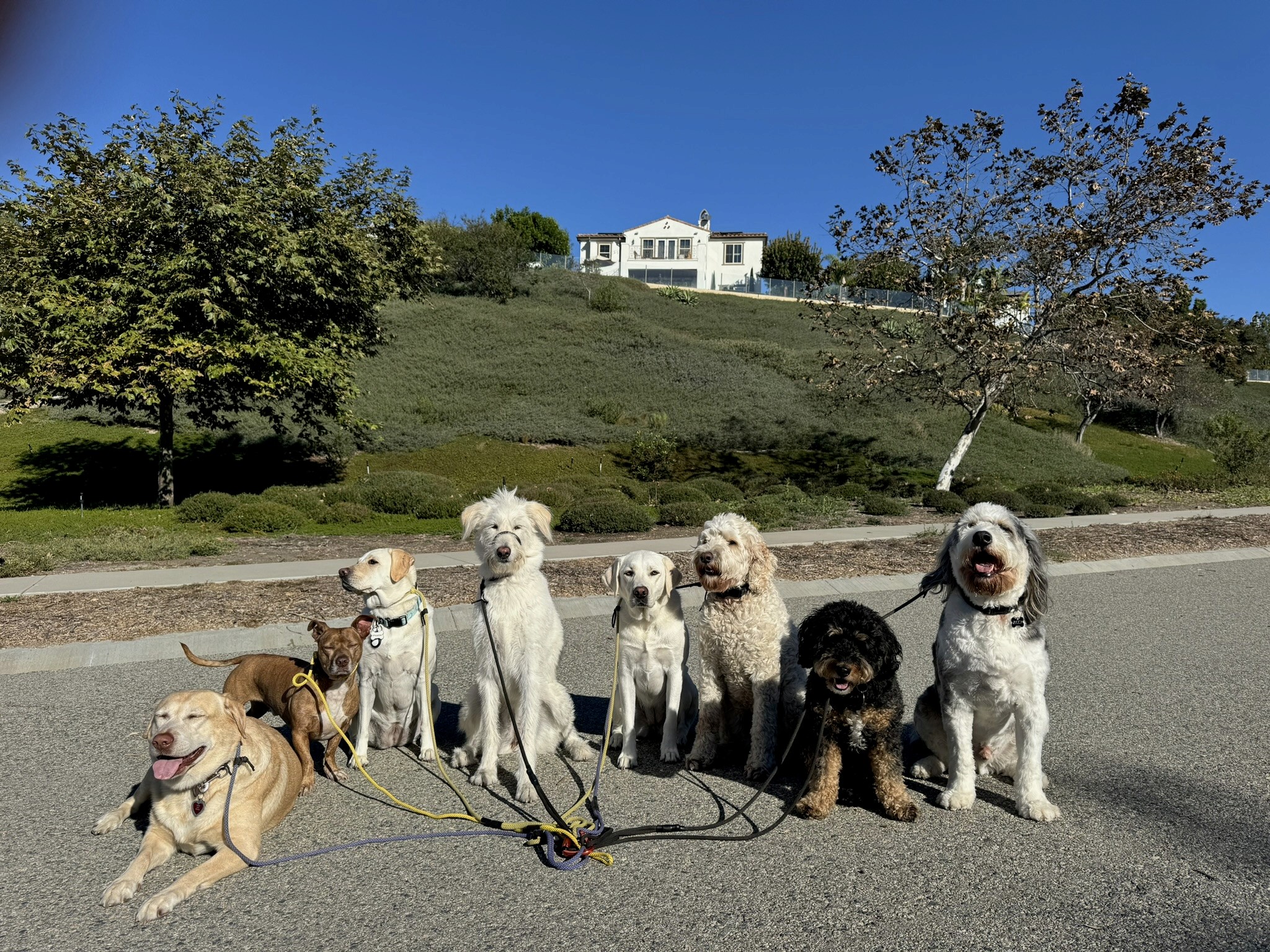
A Pup Scouts pack walk brings together dogs of all sizes and breeds for supervised outdoor adventure and socialization.
What Coto De Caza demands of a Pack Walking service
Three operational realities shape every Pack Walk in this neighborhood.
Demand 1: Gated access logistics. The Pack Leader needs reliable access through Coto De Caza's gate system. Pickup and drop-off windows have to factor in gate timing. This usually means the Pack Leader is registered with the community access list and the family communicates pickup days clearly in advance.
Demand 2: Long driveways and pickup distance. Pickup at a Coto De Caza estate isn't a curbside event. The Pack Leader walks down a long driveway, manages the dog through the property approach, and returns the same way. This adds time to every transition. The Pack Walking service has to plan for it without compressing the actual walk.
Demand 3: Trail-oriented route options. Coto De Caza's equestrian trail system gives Pack Walks something most OC neighborhoods don't have: actual trail terrain accessible during the walk window. A Coto De Caza pack often runs on dirt rather than concrete, with elevation changes that suburban routes can't offer. This shapes pace, energy expenditure, and the kind of dogs that fit best.
These demands aren't problems. They're the reasons Pack Walks fit dogs in this neighborhood differently than they fit dogs elsewhere.
Why Scout Expedition often fits Coto De Caza dogs better than Explorer Hour
The 60-minute Explorer Hour works for many Pack Walking dogs across Orange County. For Coto De Caza, the four-hour Scout Expedition often fits better.
Three reasons:
The trail terrain rewards a longer outing. A 60-minute walk on residential streets uses different muscles and energy systems than a four-hour walk through trail terrain. Coto De Caza dogs who get the longer Scout Expedition come back more thoroughly engaged.
The pickup-and-transit time is significant. Adding the Pack Leader's gate access, driveway approach, and dog handoff to a 60-minute walk means more transit than walk. The Scout Expedition's longer outing window absorbs the transit overhead naturally.
Estate-property dogs are often higher-energy adolescents or working breeds. The dogs who end up on Coto De Caza properties skew toward breeds and ages that benefit from longer structured outings: Labradors, retrievers, Aussies, working line shepherds, and similar profiles.
Some Coto De Caza dogs do well on Explorer Hour. The format choice depends on the dog, not the neighborhood. The Pack Leader recommends during the in-home assessment.
Coto De Caza Pack Walking format fit
Dog profile | Recommended format | Reasoning |
|---|---|---|
High-energy adolescent (Lab, Aussie, working breed) | Scout Expedition | The 4-hour outing absorbs energy a shorter walk can't |
Adult dog with consistent moderate energy | Either Explorer Hour or Scout Expedition | Schedule preference drives the choice |
Senior with mobility limits | Explorer Hour, light trail or residential route | Shorter outing fits the energy budget |
Confident social dog who needs peer engagement | Either format, ideally a steady weekly cadence | Pack composition matters more than length |
Anxious or reactive dog | Pack Leader assessment first; may start with Private Walks | Coto De Caza isolation can deepen anxiety; addressing first matters |
Dog with history of leash reactivity around livestock | Pack Leader evaluates trail safety carefully | The trail system passes equestrian areas; some dogs need solo work first |
The match decision is based on the dog's profile and the family's schedule, not the neighborhood category.
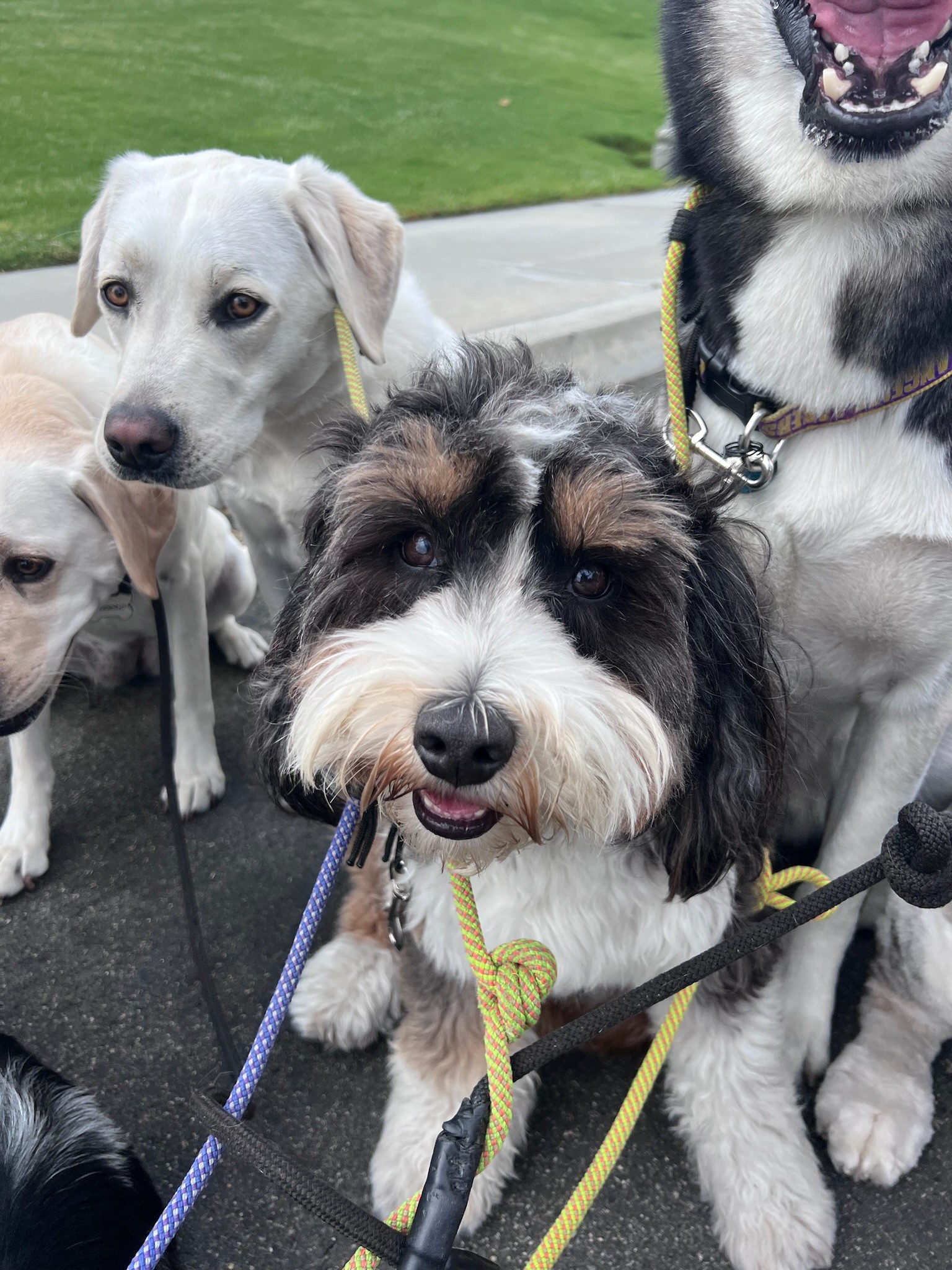
A diverse group of dogs enjoys a supervised pack walk, an ideal outing for estate-property owners seeking socialized exercise.
How a Coto De Caza Pack Walk gets routed
Pickup window planning. The Pack Leader plans the route around the gate access and pickup-and-transit overhead. Pickup typically happens 15 to 30 minutes earlier than a residential OC pickup of similar walk length, accounting for the gate and driveway approach.
Pack composition for the route. Coto De Caza's trail-oriented routes work best with packs whose energy and behavior profiles fit trail terrain. A reactive dog who handles residential blocks fine may not handle trail proximity to other animals well. The Pack Leader composes the pack with the route in mind.
Trail vs residential decision. On any given day, the Pack Leader chooses between the trail system and the residential streets within the community. The trail offers more enrichment but more variables. Residential routes offer predictability when a pack profile needs it. The choice is daily, not fixed.
Drop-off and report. After the walk, the Pack Leader returns the dog to the property, secures handoff, and sends the post-walk report card with photos and short video clips. The family receives confirmation the dog is home and engaged with details about the route, peer dynamics, and any notable behavior shifts.
What changes for a Coto De Caza dog over a few months
Coto De Caza dogs who join structured Pack Walks usually see two specific changes within the first 8 to 12 weeks.
The first change is social. Dogs who haven't seen other dogs regularly start to read peer signals more cleanly. The shy hesitation in the first few walks gives way to confident engagement. By week 8, the dog is anticipating Pack Walk days the way a less isolated dog already would.
The second change is at-home behavior. The estate-property pacing that some Coto De Caza dogs develop (the boredom-driven barking at every property fence, the over-attachment to the family during evening hours, the destructive behaviors during the workday) tends to thin out. The dog has somewhere to put their daily mental energy beyond the property.
The post-walk report card tracks both shifts visit over visit. Coto De Caza families often notice the change in their dog's evening behavior before they notice it in the report card. Both align by month three.
Common questions Coto De Caza families ask
A few specific questions come up more often in this neighborhood than elsewhere.
Will my dog be safe around the equestrian areas? The trail system in Coto De Caza passes equestrian areas with horses, riders, and occasional ranch operations. The Pack Leader knows these zones and routes the pack accordingly. Dogs with strong prey drive or unstable behavior around livestock are screened during the in-home assessment and routed through residential streets rather than trails.
My dog has the run of two acres. Do they really need a Pack Walk? Most Coto De Caza dogs do, even with private acreage. The exercise gap isn't the issue. The structured-engagement gap is. A dog with two acres of solo time still benefits significantly from a Pack Walk's social and cognitive engagement.
Can the Pack Leader handle my gate access? Yes, with setup. Pup Scouts works with the family to register the Pack Leader for community access, coordinate pickup days, and adjust if access procedures change.
Frequently Asked Questions
Does Coto De Caza's gated community access cause delays for Pack Walking pickups?
Pickups in Coto De Caza take more transit time than in non-gated OC neighborhoods. The Pack Leader plans for this. Most families don't notice the difference because the walk itself runs the full Explorer Hour or Scout Expedition window. The transit overhead is built into the schedule.
Are the equestrian trails open to dog packs?
The trail system in Coto De Caza supports recreational dog walking with appropriate routing. The Pack Leader knows which trails work for packs and which sections to avoid based on the day's pack composition and current trail conditions. Pack Walks don't disrupt equestrian use.
What if my Coto De Caza dog has never been on a Pack Walk before?
Pup Scouts uses an in-home assessment as the first visit for any new dog. The certified Pack Leader observes your dog at home, evaluates fit for Pack Walking versus Private Walks, and recommends the right starting format. Coto De Caza dogs sometimes start with Private Walks for a few weeks before joining a pack, particularly if the dog has been isolated on the property for a long stretch.
Can two dogs from the same Coto De Caza household join the same pack?
Sometimes, depending on temperament match. The decision is based on each dog's profile rather than the household. Two dogs from the same family with matched energy can share a pack. A high-energy young Aussie and a senior Lab from the same property usually need different packs.
How often should a Coto De Caza dog do Pack Walks?
Most Coto De Caza dogs benefit from 3 to 5 Pack Walking days per week, depending on energy profile and the family's schedule. Some dogs do well at 2 days per week supplemented by family activity. Some do best at 5 days per week with structured days off. The Pack Leader recommends a frequency during the in-home assessment based on what fits the dog.
Written by Mike and Colleen Bass, founders of Pup Scouts. Mike and Colleen have led structured dog care across Maryland, Orange County, and Charlotte since 2015. More about our team.
Get started with OC Pup Scouts, or call (949) 629-0932. Find us on Google as OC Pup Scouts.
Similar Blogs


