Mobile Grooming vs Salon for Newly Adopted Dogs in OC
Mike and Colleen Bass
Mobile Dog Grooming

Key Takeaways
Mobile grooming eliminates travel stress and unfamiliar environments during the critical first 90 days when newly adopted dogs are still settling into Orange County homes.
Fear-Free Certified Groomers working in your driveway can assess coat condition, skin issues, and handling tolerance without the sensory overload of a salon lobby.
The first groom sets the precedent for every groom that follows, making low-stress at-home service the better choice for rescue dogs building trust with new families.
A rescue dog walks into an Orange County home for the first time. The household sounds are unfamiliar. The furniture smells like someone else. The routine does not exist yet. In Costa Mesa or Ladera Ranch or Laguna Niguel, the first weeks are a negotiation. The dog is learning whether this place is safe. Whether these people keep their promises. Whether the crate means confinement or a den.
Somewhere in that same window, the dog needs grooming. The shelter bath was functional, not restorative. The coat may be matted. The nails are overdue. The dog may have never been groomed by a professional. The question is not whether grooming happens. The question is where it happens and what the dog experiences when it does.
Mobile dog grooming in Orange County is grooming that happens in the driveway, in the dog's new territory, with a Fear-Free Certified Groomer who handles one dog at a time. A drop-off salon is a tile-floor lobby, barking in kennels, a stranger's hands in a room the dog cannot map. For a newly adopted dog, the difference is not cosmetic. It is behavioral.
What Mobile Grooming for Newly Adopted Dogs Means
Mobile grooming for newly adopted dogs is a Fear-Free grooming service delivered in a climate-controlled van parked at the home, used to assess coat condition and build handling trust during the first 90 days post-adoption without the added stressor of an unfamiliar location. The groomer works one-on-one with the dog in a space the dog already associates with safety, making it the gentler option for rescue dogs still learning what to expect from human interaction.

A newly groomed pup sits poised and content, ready to build positive associations with professional care from the very first visit.
Why the First Groom Sets the Pattern
A dog's first professional groom is a precedent. If the experience is overwhelming, the dog remembers. If the groomer moves too fast or restrains too firmly or uses a dryer the dog has never heard before, the next groom starts from a place of resistance. For a newly adopted dog, that first groom may also be the first time a stranger has touched the dog's paws, ears, or face in this new household.
Mobile groomers working Fear-Free protocols start with what the dog can tolerate. The groomer parks in the driveway. The dog hears the van door open. The pet parent walks the dog to the van on leash. The groomer greets the dog outside the van first, offering a high-value treat, letting the dog sniff the grooming table through the open door. If the dog refuses to step into the van, the groomer does not force it. The session becomes a desensitization visit instead of a full groom.
Salons do not operate this way. The dog enters a lobby with other dogs. The intake form gets filled out. The dog goes into a kennel to wait. By the time the groomer calls the dog to the table, the dog has already spent cortisol managing the environment. For a rescue dog from a high-intake shelter or a dog with an unknown grooming history, the salon format stacks stressors before grooming even begins.
The first groom teaches the dog whether grooming is something that happens to them or something they participate in. Mobile grooming skews toward participation. Salon grooming skews toward compliance.
Comparing Mobile vs Salon for Newly Adopted Dogs
A newly adopted dog's needs are not the same as a dog who has lived in the same Orange County home for three years. The comparison is not just convenience. It is suitability.
Factor | Mobile Grooming | Drop-Off Salon |
|---|---|---|
Environment | Dog's own driveway; familiar sounds and smells from the house nearby | Tile lobby, kennels, other dogs barking; unfamiliar location the dog has never mapped |
Handling pace | Groomer adjusts session length to the dog's tolerance; can pause or stop if the dog shows stress | Scheduled appointments mean groomers work to a timeline; pausing may not be an option if the next dog is waiting |
Separation from owner | Pet parent stays visible through van window or near the van; dog knows the owner has not left the property | Dog goes into a kennel out of sight of the owner; some dogs experience this as abandonment during the vulnerable settling-in period |
First-groom flexibility | If the dog refuses the van, the session becomes desensitization only; no forced compliance | Most salons require the dog to complete intake and kennel time; backing out mid-appointment is disruptive to the schedule |
Coat assessment | Groomer works one-on-one and can spend extra time on matting, skin issues, or flea dirt without rushing | High-volume salons may prioritize speed; tangled coats on rescue dogs may get clipped short to save time |
The table is not an argument that salons are bad. It is an argument that mobile grooming is better matched to the behavioral state of a newly adopted dog in the first 90 days.
The First 90 Days: A Grooming Progression
Rescue organizations and behavior consultants refer to the first three months post-adoption as the adjustment window. The dog is still learning the household rhythm. Reactivity that was not visible at the shelter may surface. Separation anxiety may develop. Resource guarding may appear. Grooming during this window is not just about coat maintenance. It is about building positive associations with being handled by someone other than the family.
Here is how mobile grooming supports that progression across six stages:
Week 1 to 2: Desensitization visit. The groomer parks in the driveway. The pet parent brings the dog on leash. The groomer offers treats, lets the dog sniff the van, and does not attempt to groom. The goal is familiarity, not service. If the dog shows stress, the session ends. If the dog is calm, the groomer may brush the dog outside the van for two minutes and end on a positive note.
Week 3 to 4: Partial groom. The dog enters the van. The groomer completes nails, ears, and a sanitary trim only. No full bath, no blow-dry. The session lasts 20 minutes. The dog exits the van and gets a high-value reward from the pet parent immediately. The precedent is set: van equals short interaction, then reward.
Week 5 to 6: First full bath. The groomer completes a bath, nails, ears, and light trimming. If the dog tolerates the dryer on low, the groomer uses it. If the dog shows stress, the groomer towel-dries and schedules dryer desensitization for the next visit. The session lasts 45 minutes.
Week 7 to 8: Coat evaluation and plan. The groomer assesses whether the dog's coat is matted, whether the skin shows flea dirt or irritation, and whether the dog needs a breed-specific trim or a maintenance clip. For double-coated breeds common in OC shelters (Huskies, Australian Shepherds, German Shepherds), the groomer explains why shaving is not recommended and proposes a de-shedding schedule instead.
Week 9 to 10: Full groom with style. The dog receives the same service a long-term client dog would receive: bath, blow-dry, nails, ears, breed-appropriate trim or hand-stripping if relevant, and teeth brushing if the dog allows it. The groomer takes pre- and post-groom photos for the pet parent's records.
Week 11 to 12: Routine established. The dog now associates the mobile grooming van with a predictable sequence. The pet parent books the next appointment for six weeks out. The dog's grooming needs are no longer reactive (matting, overgrown nails, emergency cleanup). They are proactive.
This is a progression that works in a driveway. It does not work in a salon, where the first visit is usually a full-service appointment and the dog either tolerates it or does not.
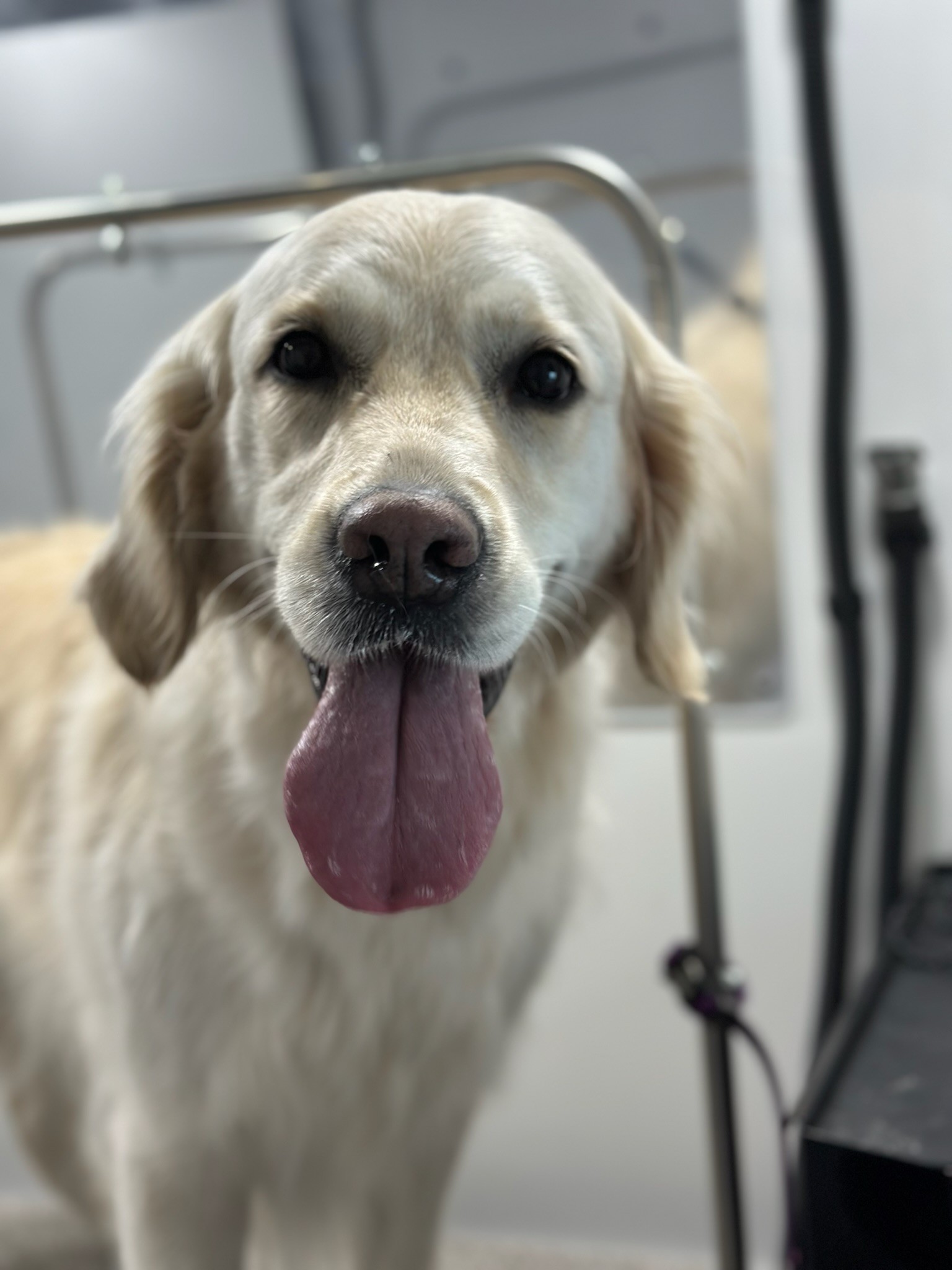
A calm, content pup during grooming demonstrates the trust-building that Fear-Free practices create with rescue dogs.
Why Fear-Free Certification Matters for Rescue Dogs
Fear-Free is a veterinary-backed handling protocol that prioritizes the dog's emotional state during grooming, medical care, and training. A Fear-Free Certified Groomer has completed coursework in canine body language, stress signals, and low-stress handling techniques. For a newly adopted dog, this is not optional.
Rescue dogs may have handling histories the new owner does not know. A dog from a hoarding case may have never been brushed. A dog from a high-kill shelter may have been forcibly restrained during intake procedures. A dog surrendered by an elderly owner may have only been groomed once a year and may associate grooming with pain if matting was clipped too close to the skin.
A Fear-Free groomer reads the dog's signals before starting. Whale eye (whites of the eyes visible). Lip licking. Yawning. Tucked tail. Frozen posture. If the groomer sees any of these, the session slows or stops. The groomer may offer a break, a treat, or a chance for the dog to exit the van and reset. The goal is not to finish the groom. The goal is to keep the dog under threshold.
Our Orange County mobile grooming team includes Fear-Free Certified Groomers who have worked with hundreds of newly adopted dogs across Costa Mesa, Irvine, Mission Viejo, and Laguna Niguel. The approach is the same whether the dog is a 10-pound Chihuahua mix or an 80-pound Shepherd mix: the dog sets the pace, and the groomer follows.
When a Salon Might Still Be the Right Choice
Mobile grooming is not a universal answer. Some newly adopted dogs are resilient. Some rescue dogs came from foster homes where they were groomed regularly and show no stress in new environments. Some Orange County pet parents do not have driveway access (apartment complexes, gated communities with restricted vendor entry, townhomes with shared driveways).
A salon may be the right choice if the dog shows confidence in unfamiliar places, if the pet parent has used the same salon for years and trusts the groomers, or if the dog's coat requires equipment the mobile van does not carry (hydraulic grooming tables for giant breeds, specialized hand-stripping tools for wire-coated terriers).
The question is not whether salons are competent. The question is whether the salon format matches the dog's current behavioral state. For a newly adopted dog in the adjustment window, the answer is usually no.
What Newly Adopted Dog Owners in Orange County Should Know
Orange County has one of the highest rescue adoption rates in California. Dogs come from local shelters (OC Animal Care, DAWG, Love Bug Rescue), out-of-state transports (Texas, New Mexico), and international rescues (Mexico, South Korea). The dogs arrive with different grooming needs and different levels of handling tolerance.
The first groom is not about aesthetics. It is about setting a baseline. If the dog's nails are overgrown, the groomer may only trim the tips during the first session to avoid hitting the quick. If the dog's coat is matted, the groomer may recommend a maintenance clip instead of trying to brush out mats that will cause pain. If the dog shows signs of skin irritation or flea dirt, the groomer documents it and recommends a vet check before the next groom.
Mobile grooming gives the groomer time to assess without rushing. It gives the dog time to acclimate without the pressure of other dogs waiting. It gives the pet parent transparency, because the van is parked 20 feet from the front door and the owner can check in if needed.
For a newly adopted dog, that transparency matters. The dog is learning to trust the household. Watching the dog walk into a salon and disappear behind a door does not build trust. Watching the dog walk to a van in the driveway, seeing the groomer work through the van window, and greeting the dog when the session ends does.
Frequently Asked Questions
How soon after adoption should a newly adopted dog be groomed?
Wait at least one week to let the dog settle into the household routine, then schedule a desensitization visit where the groomer meets the dog without attempting a full groom. Full grooming can begin in week three if the dog shows calm body language during the desensitization visit.
What if my newly adopted dog has severe matting from the shelter?
A Fear-Free mobile groomer will assess whether the mats can be brushed out or whether a maintenance clip is safer and less painful. Severe matting close to the skin often requires clipping, and the groomer will explain why and show the pet parent the areas being addressed.
Can mobile groomers handle dogs with aggression or extreme fear?
Mobile groomers trained in Fear-Free protocols can work with fearful dogs by breaking sessions into shorter intervals and using high-value treats and calming techniques. For dogs with a bite history or severe aggression, the groomer may recommend a veterinary behaviorist consultation first and coordination with the dog's trainer.
Do mobile groomers charge more for newly adopted dogs?
Pricing is based on coat condition, not adoption status. A newly adopted dog with heavy matting or a double coat requiring de-shedding may cost the same as any dog with similar grooming needs. Some mobile groomers offer a first-visit discount for rescue dogs, but this varies by provider.
What should I tell the mobile groomer about my dog's history?
Share everything you know, even if it is incomplete. Known triggers (clippers, nail grinders, water spray), prior grooming experiences (good or bad), any medical issues (skin conditions, ear infections, arthritis), and the dog's general stress tolerance in new situations. The more the groomer knows, the better the session goes.
Written by Mike and Colleen Bass, founders of Pup Scouts. Mike and Colleen have led structured dog care across Maryland, Orange County, and Charlotte since 2015. More about our team.
Get started with OC Pup Scouts, or call (949) 629-0932. Find us on Google as OC Pup Scouts.
Similar Blogs


