Dog Walking in Orange County: The Discovery Visit
Mike and Colleen Bass
Pack Walking

Key Takeaways
The Discovery Visit is a 30-minute in-home consult where a certified Pack Leader meets your dog before any walk happens.
We observe temperament, leash behavior, household dynamics, and neighborhood conditions to determine whether pack walking, private walking, or training fits best.
Every Discovery Visit ends with a written recommendation and a clear next step, not a hard-sell pitch.
A certified Pack Leader pulls up to a Dana Point home at 9:30 on a Wednesday morning. The gate is latched. Two dogs bark from the other side of the front door. The street is quiet except for landscaping crews three houses down. The Pack Leader waits at the curb until the owner opens the door and steps outside with both dogs on-leash.
This is the Discovery Visit. It happens before we ever take your dog on a walk. No payment. No commitment. Just observation, questions, and a documented recommendation.
Most dog walking services in Orange County skip this step. A client books online, a walker shows up the next day, and the match happens on the fly. That works if all you need is exercise. It does not work if you want behavior consistency, safe group dynamics, or a walking routine that actually holds.
The Discovery Visit is how we determine fit.
What the Discovery Visit Is
The Discovery Visit is a 30-minute consult at your home where a certified Pack Leader meets your dog, observes household dynamics, walks a short loop around your neighborhood, and documents what they see. It determines whether your dog is ready for pack walking, whether private walking makes more sense, or whether structured training should come first.
It is not a sales call. It is an assessment.

Eight dogs of different sizes and colors sit lined up together on a paved surface with trees and a house in the background.
Why We Do Not Skip This Step
Most dog walking services treat the first walk as the trial. The walker shows up, clips the leash, and figures out the dog on the route. If the dog pulls, reacts, or struggles in the group, the walker makes a note and adjusts next time.
Pup Scouts does not operate that way. We match dogs to groups based on temperament, not availability. A dog who freezes when other dogs approach does not belong in a pack of six confident walkers. A dog who pulls toward every person on the sidewalk needs private work before joining a structured group.
The Discovery Visit catches these dynamics before the first walk happens. It protects the dog, the group, and the consistency we promise every client.
The Four Stages of the Discovery Visit
Here is what happens during every Discovery Visit in Orange County, stage by stage.
Stage 1: Observation Before Contact
The Pack Leader arrives at the scheduled time but does not walk straight to the door. They watch the house first. Is the dog barking at the window? Is the owner struggling to hold the leash while opening the door? Is the dog calm or amped?
This observation happens from the curb or the driveway. It tells us how the dog responds to arrival cues. A dog who launches at the door the second a car pulls up is showing excitement that will carry into the walk. A dog who sits calmly at the window is showing composure we can build on.
The Pack Leader also notes the neighborhood layout. Is the sidewalk wide or narrow? Is there street parking that blocks sightlines? Are there other dogs visible in yards? These details matter when we design the walking route later.
Stage 2: Greeting and Leash Behavior
Once the owner steps outside with the dog on-leash, the Pack Leader greets the human first. Not the dog. This is intentional. Dogs learn that new people are interesting when humans react to them first. We reverse that pattern.
The Pack Leader then asks the owner to walk the dog in a small loop on the driveway or front walkway. We watch leash tension, pulling, sniffing, and focus. Does the dog check in with the owner? Does the dog pull toward the Pack Leader? Does the dog ignore both and scan the environment?
This is not a test the dog passes or fails. It is data. A dog who pulls constantly is not a bad dog. A dog who pulls constantly needs structured leash work before joining a group walk where five other dogs are holding a neutral pace.
Stage 3: Household and Routine Questions
The Pack Leader asks a short list of questions. These are not intake-form questions. They are behavior questions.
What does your dog do when you leave the house? What does your dog do when you come home? Does your dog react to other dogs on walks? Does your dog have recall off-leash? Has your dog ever shown aggression toward people or other dogs? What does a typical day look like?
The answers tell us whether the dog is bored, anxious, under-stimulated, over-stimulated, or ready for group structure. A dog who paces at the window all day and launches out the door every evening is under-exercised. A dog who barks at every passing dog on the block is showing reactivity that structured walks can address, but not on day one.
We also ask what the family wants. Some families need daily exercise. Some families need behavior improvement. Some families need both. The Discovery Visit is where we align expectations with reality.
Stage 4: The Walk and the Recommendation
The Pack Leader walks a short loop with the dog and the owner. Usually 5 to 10 minutes. We are not testing stamina. We are watching how the dog responds to real-world conditions.
Does the dog pull toward other dogs? Does the dog freeze when a car passes? Does the dog check in when the handler stops? Does the dog ignore distractions or fixate on them?
At the end of the loop, the Pack Leader delivers a verbal recommendation. Pack walking if the dog is ready. Private walking if the dog needs one-on-one work first. Training if the dog needs foundational skills before walking structure makes sense.
The recommendation is documented in writing and sent to the family within 24 hours. It includes the reasoning, the next step, and the timeline.
What Happens After the Discovery Visit
If the recommendation is pack walking, we match the dog to a group based on energy, size, and temperament. Not the next available slot. Not the group closest to the house. The group where the dog will succeed.
If the recommendation is private walking, we assign a consistent Pack Leader who works with the dog one-on-one until the dog is ready for group structure.
If the recommendation is training, we refer the family to structured training options and pause the walking conversation until the foundation is in place.
Some families push back. They booked a dog walker, not an assessment. They want the walk to start next week. We hold the line. A dog who is not ready for pack structure does not improve by being thrown into it. A dog who needs private work does not benefit from being rushed into a group.
The Discovery Visit protects the dog. It also protects the pack.
What We Observe That Most Walkers Miss
Door Behavior
A dog who bolts out the door the second it opens is showing impulse control issues. That behavior does not disappear on a walk. It shows up at every intersection, every curb, every time another dog passes.
Most walkers do not see this because they do not watch the door. They meet the dog on the sidewalk after the owner has already wrestled them outside.
Leash Tension at Rest
A dog who keeps the leash taut even when standing still is showing low tolerance for stillness. That dog will pull through the entire walk unless we address it first.
Most walkers assume pulling is about excitement. Sometimes it is. Sometimes it is about a dog who has never learned that calm movement is an option.
Reactivity Patterns
A dog who barks at one passing dog but ignores another is showing selective reactivity. That selectivity tells us what the dog is reacting to. Size. Energy. Movement speed. Sound.
Most walkers label a dog "reactive" and stop there. We label the pattern and adjust the route accordingly.
Owner Influence
A dog who behaves one way with the owner and another way with the Pack Leader is showing learned behavior. The owner may be reinforcing pulling by stopping every time the dog yanks. The owner may be reinforcing barking by pulling the dog closer when another dog approaches.
The Discovery Visit shows us what the dog knows and what the owner has unintentionally taught. We work with both.
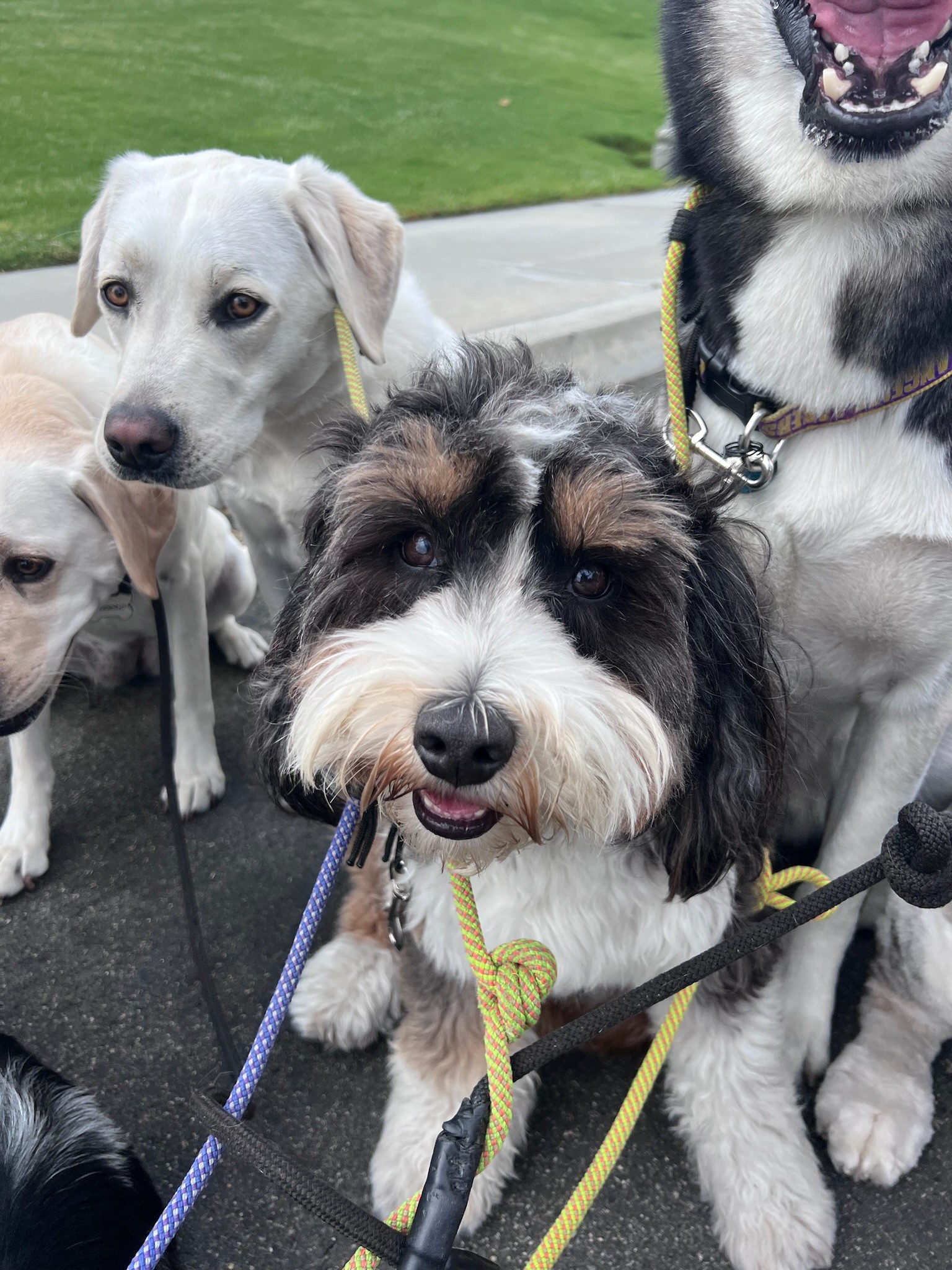
Four dogs of varying sizes stand together on a driveway, each on a colored leash.
How This Changes the First Walk
When the first walk happens, the Pack Leader already knows the dog. They know the dog pulls left at intersections. They know the dog freezes when skateboards pass. They know the dog checks in after 10 minutes but not before.
The walk is not a trial. It is a continuation of the plan we built during the Discovery Visit.
Most dog walking services treat every first walk as a discovery process. The walker learns the dog while walking the dog. That works if the goal is just exercise. It does not work if the goal is behavior improvement and group consistency.
Why Families in Orange County Value This
Orange County moves quickly. Families book services online and expect them to start the next day. The Discovery Visit asks families to wait. Some appreciate it immediately. Some question it until they see the results.
A Laguna Niguel family with a 9-month-old Aussie booked a Discovery Visit in May. The dog was energetic but not reactive. The Pack Leader recommended pack walking but flagged that the dog needed two weeks of private walks first to build leash manners.
The family wanted pack walks immediately. We held the recommendation. After two weeks of private walks, the dog joined a group. The first pack walk went smoothly because the foundation was in place.
That does not happen when you skip the Discovery Visit.
From First Contact to Consistent Routine
Stage | What happens | Timeline |
|---|---|---|
Discovery Visit scheduled | Family books online or calls; receives confirmation email with prep instructions | Same day |
Discovery Visit completed | Pack Leader meets dog, walks loop, delivers verbal recommendation | 30 minutes |
Written recommendation sent | Family receives documented plan with reasoning and next steps | Within 24 hours |
Service starts | Dog begins pack walking, private walking, or referred to training | 3 to 7 days after acceptance |
The Discovery Visit adds one step to the process. It also removes the guesswork, the mismatched groups, and the first-walk surprises that other services treat as normal.
Frequently Asked Questions
Does the Discovery Visit cost anything?
No. The Discovery Visit is complimentary. It is part of how we determine whether we are the right fit for your dog.
What if my dog does not pass the Discovery Visit?
The Discovery Visit is not a pass-fail test. It is an assessment. If your dog is not ready for pack walking, we recommend private walking or training first. We do not turn dogs away. We match them to the service that works.
How long does the Discovery Visit take?
30 minutes. The Pack Leader stays longer if needed, but most visits finish within that window.
Can I be present during the Discovery Visit?
Yes. We ask that you step outside with your dog on-leash so the Pack Leader can observe your dog's behavior with you present. This is part of the assessment.
What happens if I disagree with the recommendation?
We explain the reasoning and answer questions. If you still want to proceed with a different service than recommended, we document the request and move forward. The recommendation is guidance, not a requirement.
Written by Mike and Colleen Bass, founders of Pup Scouts. Mike and Colleen have led structured dog care across Maryland, Orange County, and Charlotte since 2015. More about our team.
Get started with OC Pup Scouts, or call (949) 629-0932. Find us on Google as OC Pup Scouts.
Similar Blogs


