Dog Behaviorist vs Dog Trainer in Maryland: Who to Call
Mike and Colleen Bass
Board & Train

Key Takeaways
A dog trainer teaches skills and changes everyday behavior, while a veterinary behaviorist is a veterinarian board-certified in behavior who can diagnose medical causes and prescribe medication.
A Certified Applied Animal Behaviorist (CAAB) holds a doctorate and is certified by the Animal Behavior Society, while certified behavior consultants sit between trainers and behaviorists.
Most problem behavior, including leash pulling, jumping and barking at the door, is a trainer's job, but a bite, a sudden change in behavior or a possible medical cause starts with your veterinarian.
You love your dog, and something they're doing has started to worry you, whether it's lunging at other dogs, barking at everyone who passes the door, or a growl that came out of nowhere. Now you're trying to work out who to call, and the dog behaviorist vs dog trainer question is genuinely confusing, because the titles sound so alike.
Here's the plain answer. A dog trainer teaches skills and changes everyday behavior, while a veterinary behaviorist is a veterinarian board-certified in behavior who can diagnose medical causes and prescribe medication. Most problem behavior is a trainer's job, and a bite, a sudden change or a possible medical cause starts with your vet. When a trainer is the right fit, we offer weekly in-home training and Board and Train in Baltimore.
What a dog behaviorist is
A dog behaviorist is a professional with certified, advanced training in animal behavior, either a veterinary behaviorist or a Certified Applied Animal Behaviorist, used to assess and treat serious or complex behavior problems for dogs whose needs go beyond everyday training. Outside those two credentials, "behaviorist" isn't a protected title, so it's worth asking what training sits behind the word.

A brown dog on a colorful leash stands on a paved driveway with trees and fencing visible in the background.
Trainers, Behavior Consultants and Behaviorists, Explained
If the letters after people's names have started to blur together, you're far from alone, so here's who's who.
Dog trainers teach skills like loose-leash walking and settling on a mat, and they change everyday habits through practice. Training isn't a licensed profession, so ask about certification, such as the exam-based credentials from the Certification Council for Professional Dog Trainers (CCPDT), which also require hands-on hours and continuing education.
Certified behavior consultants focus on fear, reactivity and anxiety. The International Association of Animal Behavior Consultants (IAABC) certifies consultants who've documented hundreds of consulting hours and submitted case studies, and the CCPDT offers a behavior consultant credential too. Like trainers, they don't diagnose or prescribe.
Certified Applied Animal Behaviorists (CAABs) are certified by the Animal Behavior Society. A full CAAB has a doctorate in animal behavior or a related science, or a veterinary degree plus a behavior residency, along with years of applied experience, and an Associate CAAB holds a master's degree. Most work by referral from veterinarians.
Veterinary behaviorists are veterinarians who've completed a behavior residency and passed a board exam to become a Diplomate of the American College of Veterinary Behaviorists (DACVB). They can diagnose medical causes, prescribe medication and build a full treatment plan, and they're in short supply in many areas.
The ASPCA's guide to finding behavioral help explains each credential in more detail.
Dog Behaviorist vs Dog Trainer at a Glance
Here's everyone side by side, to make that first call easier:
Who | Training behind the title | What they can do | When to call |
|---|---|---|---|
Your veterinarian | Licensed veterinarian | Rule out pain and illness, prescribe, refer | First, for any bite or sudden change |
Dog trainer | No license required; certified trainers pass an exam | Teach skills, change everyday habits | Pulling, jumping, door barking, reactivity on walks |
Certified behavior consultant | IAABC or CCPDT certification with documented case work | Behavior modification for fear and anxiety | When training stalls on a fear-based problem |
CAAB | Doctorate plus applied experience, Animal Behavior Society | Assess complex cases, design behavior modification | Serious cases, usually by vet referral |
Veterinary behaviorist | Veterinarian with a behavior residency and ACVB board exam | Diagnose, prescribe, lead treatment | Bites, severe anxiety, possible medical causes |
For most dogs, the right first call is either a trainer or your vet, and a good professional on either side will tell you when to bring in someone else.
Does Your Dog Need a Trainer or a Behaviorist?
It's natural to wonder whether your dog's problem is "serious enough" for a specialist, especially after living with it for a while. Most of the time, the answer is a trainer, because leash pulling, jumping on guests, barking at the door, reactivity on walks and many separation struggles are learned behaviors that change with steady practice where they happen.
Some situations call for your vet first: a bite or a near miss, any sudden change in a dog who used to be easygoing, or a house-trained dog who starts having accidents, because pain and illness can show up as snapping, hiding or restlessness. If your dog panics when left alone, to the point of hurting themselves, talk to your vet as well as a trainer, since medication helps some dogs with separation anxiety feel calm enough to learn. Your vet can then refer you to a veterinary behaviorist when a case is severe or likely to need medication.
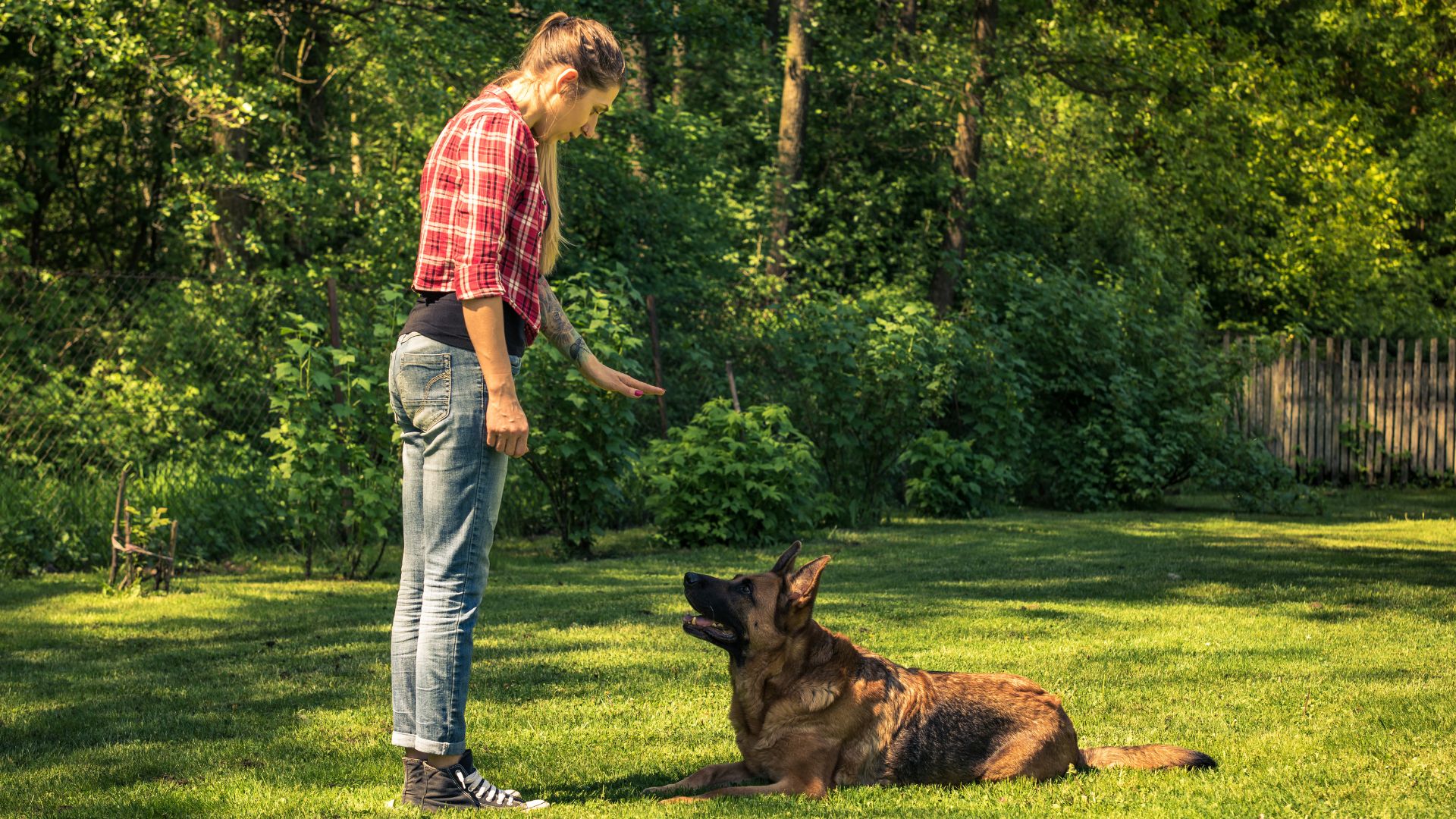
A handler works with a German Shepherd on a grassy lawn surrounded by trees.
How to Decide Who to Call First
When you're worried about your dog, it's hard to think in order, so here's a simple sequence to follow.
Check for anything new or sudden. If the behavior appeared out of the blue or your dog seems sore or off their food, see your vet first, so you aren't training around a problem medical care could solve.
Put safety first after a bite. Call your vet, and in the meantime use leashes, gates and closed doors to keep your dog away from whatever sets them off. Managing the risk now protects everyone, your dog included.
Write down what you're seeing. Note when, where and how often it happens and what came just before, and film it if that's safe. A clear record helps whoever you call see the pattern sooner.
Ask about credentials and methods. Ask who certified them, how they'll teach new behavior and what tools they use. A good professional will happily walk you through their background.
Ask who they refer to. A good trainer can name the vet or behaviorist they'd send you to if your dog needs more, which shows they know where their expertise ends.
Where Board and Train Fits
If your vet has ruled out a medical cause and the problem is a training one, there are two ways we can help. To be clear, our trainers are certified dog trainers, not veterinary behaviorists, so anything medical stays with your vet.
Board & Train is our immersive option. Your dog lives in the trainer's home, not a kennel or a facility, and trains one-on-one every day in a real-world environment. The 5-Day program covers foundational obedience and leash manners, with a customized plan, progress updates and two private follow-up lessons. The 12-Day program runs two weeks plus a weekend and covers obedience, impulse control, behavior modification and distraction-proofing, with three private follow-up lessons, a complete owner transfer session and continued guidance. Our guide to how Board and Train works in Maryland goes into more depth.
The other route is weekly in-home dog training in Baltimore, which starts with a consultation call and a private in-home assessment, then a custom program with weekly progress reports. Our Leash Reactivity & Aggression Control program is built for dogs who bark, lunge or show fear on walks, and if you're weighing the two, we've compared Board & Train and weekly sessions.
Training for Baltimore Sidewalks
If you walk a reactive dog in Baltimore, you already know how little room the city gives you. Rowhouse blocks put your dog a few feet from stoops, open doors and other dogs on narrow sidewalks, and with parked cars lining the curb, there's rarely room to back away when something sets them off.
When we start weekly training with a Baltimore dog, the work happens on your stoop, along your block and at the corner where your dog usually struggles, because that's where the behavior lives. In Columbia and across Howard County, the shared pathways bring their own close passes with bikes and strollers, and we train for those the same way.
Frequently Asked Questions
What does a dog behaviorist do?
A dog behaviorist assesses and treats serious or complex behavior problems, such as aggression, severe fear and compulsive behavior. A veterinary behaviorist can also diagnose medical causes and prescribe medication, while a Certified Applied Animal Behaviorist designs behavior modification plans alongside your vet.
Do I need a referral to see a veterinary behaviorist?
Policies vary, so it's worth asking when you call. Either way, a recent exam and your vet's records give a veterinary behaviorist a head start, which is one more reason to see your own vet first.
Can a dog trainer help with aggression?
A skilled trainer can help with a lot of reactivity and some aggression, especially the barking and lunging on walks. If your dog has bitten, or the aggression is new or getting worse, please see your vet first, because pain and illness can cause it, and your vet can refer you to a veterinary behaviorist if needed.
Does Board and Train replace a behaviorist?
It doesn't, and it isn't meant to. Board & Train is intensive, one-on-one training for obedience, leash manners and impulse control, while a veterinary behaviorist treats behavior with a medical side. Still choosing a format? Our post on weekly in-home training vs Board and Train can help.
How do I find a dog behaviorist in Maryland?
Start with your vet, who can examine your dog and refer you to the right person. The American College of Veterinary Behaviorists and the Animal Behavior Society both keep directories on their websites, and if it turns out your dog needs a trainer, we'd be glad to help in Baltimore and across Maryland.
Written by Mike and Colleen Bass, founders of Pup Scouts. Mike and Colleen have led structured dog care since 2015, built on a simple belief: your dog deserves to be treated like one of our own. More about our team.
Whatever your dog is going through, we'd love to help you find the right next step, even when that step is a call to your vet. Get started with MD Pup Scouts, or call (410) 980-7855. Find us on Google as MD Pup Scouts.
Similar Blogs


