Dog Walking in OC: Explorer Hour or Scout Expedition
Mike and Colleen Bass
Pack Walking

Key Takeaways
Explorer Hour is a 60-minute structured group walk for dogs who need daily movement and social exposure without extended outings.
Scout Expedition is a 4-hour adventure combining pack walks, enrichment stops, and structured downtime for high-energy dogs or multi-walk schedules.
Both formats hold 5 to 8 temperament-matched dogs per Pack Leader and reinforce leash manners, neutral greetings, and recall cues throughout the outing.
A Mini Australian Shepherd in Irvine spent three afternoons a week at daycare. High energy, good with other dogs, but home behavior deteriorated. Mouthing. Counter-surfing. Pacing at windows. The family switched to Scout Expeditions twice weekly. Four-hour outings that burned mental and physical energy in equal measure. The pacing stopped within two weeks.
A Labrador mix in Newport Beach needed daily structure but not marathon outings. Sixty minutes of pack walking five mornings a week gave her routine, tired her enough for afternoon naps, and built recall that held through beach distractions. Explorer Hour fit the schedule. The dog thrived.
Orange County families face a service choice: 60-minute dog walking in Orange County through Explorer Hour, or 4-hour Scout Expeditions for dogs who need more. Both are Pack Walking Adventures. Both follow the same handler-to-dog ratio, structured route protocols, and behavior-first methods. The difference is duration, pacing, and what each format delivers.
What Explorer Hour and Scout Expedition Are
Explorer Hour is a 60-minute group walk where 5 to 8 dogs share a structured outing led by a consistent Pack Leader. Routes cover neighborhood sidewalks, parks, or coastal paths. Dogs practice loose-leash walking, neutral greetings when another dog or person approaches, and recall work at designated stops. The outing moves at a steady pace. No extended play sessions. No downtime sprawl.
Scout Expedition is a 4-hour adventure that includes pack walking, enrichment breaks, scent work intervals, and structured rest periods. Dogs cover more ground, encounter more stimuli, and get mental fatigue layered on top of physical output. It replaces multi-walk schedules for high-drive dogs or serves as twice-weekly reset outings for working-line breeds.
Both formats build composure around distractions. Both reinforce training cues outside the home. The choice comes down to your dog's energy profile and what your household schedule requires.
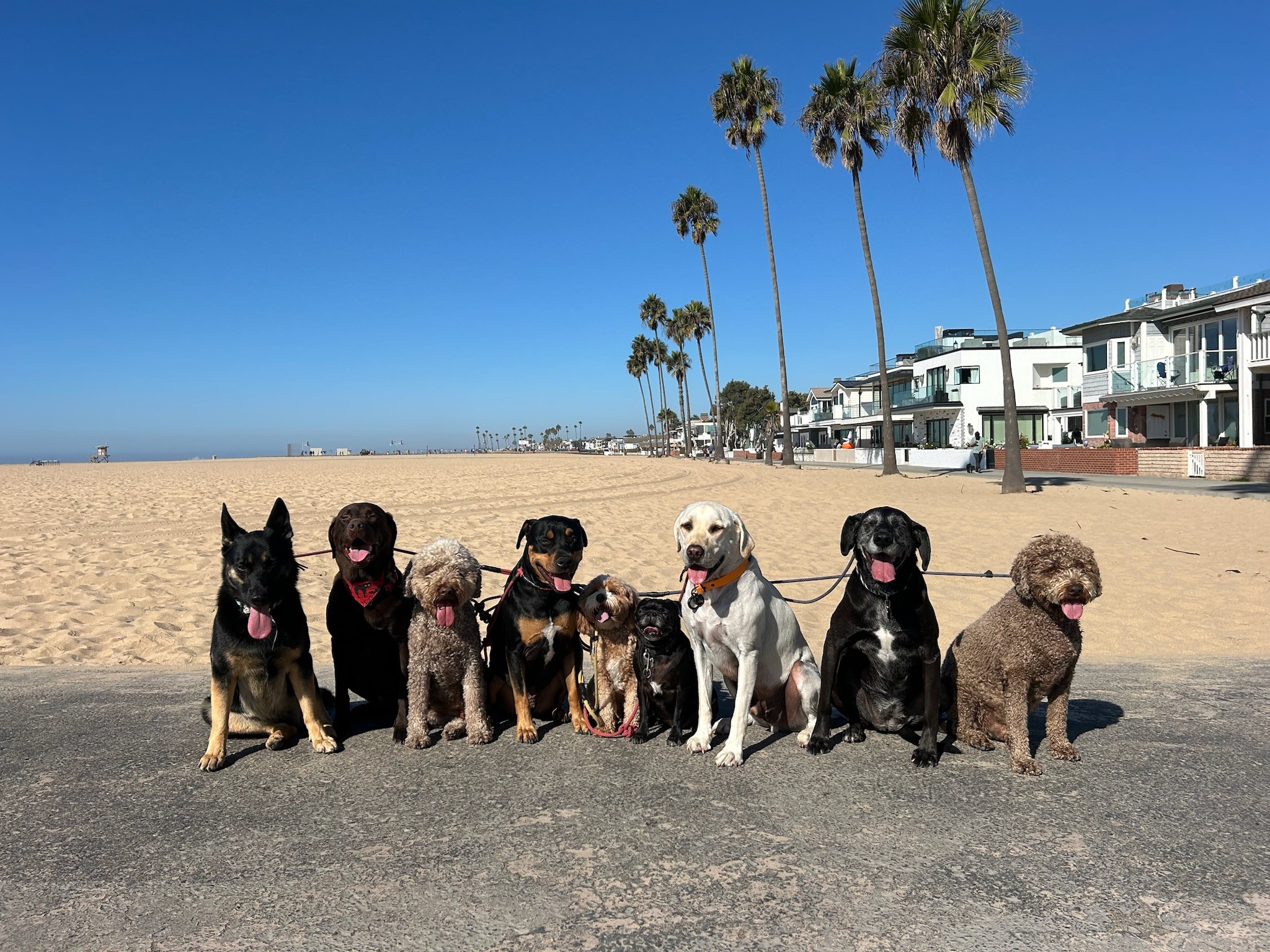
Eight dogs of varying sizes and coat colors sit lined up together on the sand near the shoreline.
Energy Profiles That Fit Each Format
Not every dog needs four hours. Not every dog gets tired in sixty minutes.
Explorer Hour works best for:
Dogs who need daily movement but moderate in intensity naturally. Older Labs who still want the walk but tire faster than they used to. Small breeds with shorter stride length who cover ground quickly in an hour. Dogs new to pack walks who benefit from shorter exposure before scaling up. Families with consistent weekday schedules who want the same walk time every morning or afternoon.
Scout Expedition works best for:
Working-line breeds who pace at home after standard walks. Adolescent dogs going through the high-energy teenage phase. Multi-dog households where one dog drains the owner's bandwidth on solo walks. Dogs transitioned off daycare who need structured alternatives without the free-for-all chaos. Families who work long hours and need their dog genuinely tired by evening.
The Irvine Mini Aussie fit the second list. The Newport Lab fit the first.
How Each Format Structures the Outing
Explorer Hour: 60-Minute Protocol
The Pack Leader arrives. Dogs load into the transport van in a calm, structured sequence. No rushing. No jumping. The route begins within five minutes of departure.
First 20 minutes: loose-leash walking on neighborhood sidewalks or park perimeter paths. Dogs practice heel position, especially near intersections or when pedestrians pass. Pack Leaders issue gentle corrections for pulling or sniffing distractions.
Middle 20 minutes: neutral greetings and recall intervals. The pack encounters other walkers, cyclists, or off-leash dogs at parks. Each dog holds position while the distraction passes. Recall cues get practiced at open grass sections or quiet cul-de-sacs.
Final 20 minutes: cooldown lap and return to van. Pace slows slightly. Dogs decompress but stay engaged. No chaotic wind-down. The outing ends as structured as it began.
Post-walk report cards arrive within an hour. Photos show the pack mid-route. Notes detail which cues each dog practiced and how they responded.
Scout Expedition: 4-Hour Protocol
The Pack Leader picks up between 8 and 9 a.m. First hour mirrors Explorer Hour structure: neighborhood sidewalks, loose-leash intervals, neutral greetings around early-morning foot traffic.
Hour two: trail or beach segment. More ground covered. Dogs encounter new terrain, new scents, elevation changes if the route includes hills. Mental engagement climbs as the environment gets richer.
Hour three: enrichment break and scent work interval. The pack stops at a designated park or open space. Dogs practice place commands on mats or benches. Pack Leader hides treats in snuffle areas or under cones for structured scent games. This is not free play. It is controlled enrichment with training cues embedded.
Hour four: cooldown walk and structured rest. Dogs return to the van for water breaks. Some routes include a second short walk segment before final return home. By the time dogs arrive back, they have burned physical energy, processed environmental stimulation, and practiced a dozen training cues across varied contexts.
Scout Expedition dogs sleep harder. Behavior improvements compound faster. The tradeoff is time commitment and cost.
Comparison: Explorer Hour vs Scout Expedition
Factor | Explorer Hour | Scout Expedition |
|---|---|---|
Duration | 60 minutes | 4 hours |
Frequency | Daily or 5× weekly | 2 to 3× weekly |
Energy burn | Moderate to tires most dogs enough for afternoon rest | High to replaces multi-walk days or heavy exercise needs |
Training cues practiced | 4 to 6 (loose-leash, neutral greetings, recall, heel) | 8 to 12 (all Explorer cues + place, scent work, extended hold durations) |
Environment variety | Neighborhood sidewalks, local parks, or coastal paths | Multi-terrain: trails, beaches, parks, enrichment stops |
Best for | Dogs needing daily routine and moderate output | High-drive dogs, adolescent energy phases, multi-walk replacement |
Cost per outing | Lower to shorter handler time | Higher to extended handler commitment and mileage |
Both formats hold the same Pack Leader every time. Both maintain 5 to 8 dogs per group. Both follow Pup Scouts Approved protocols for safety, hydration, and behavior reinforcement.
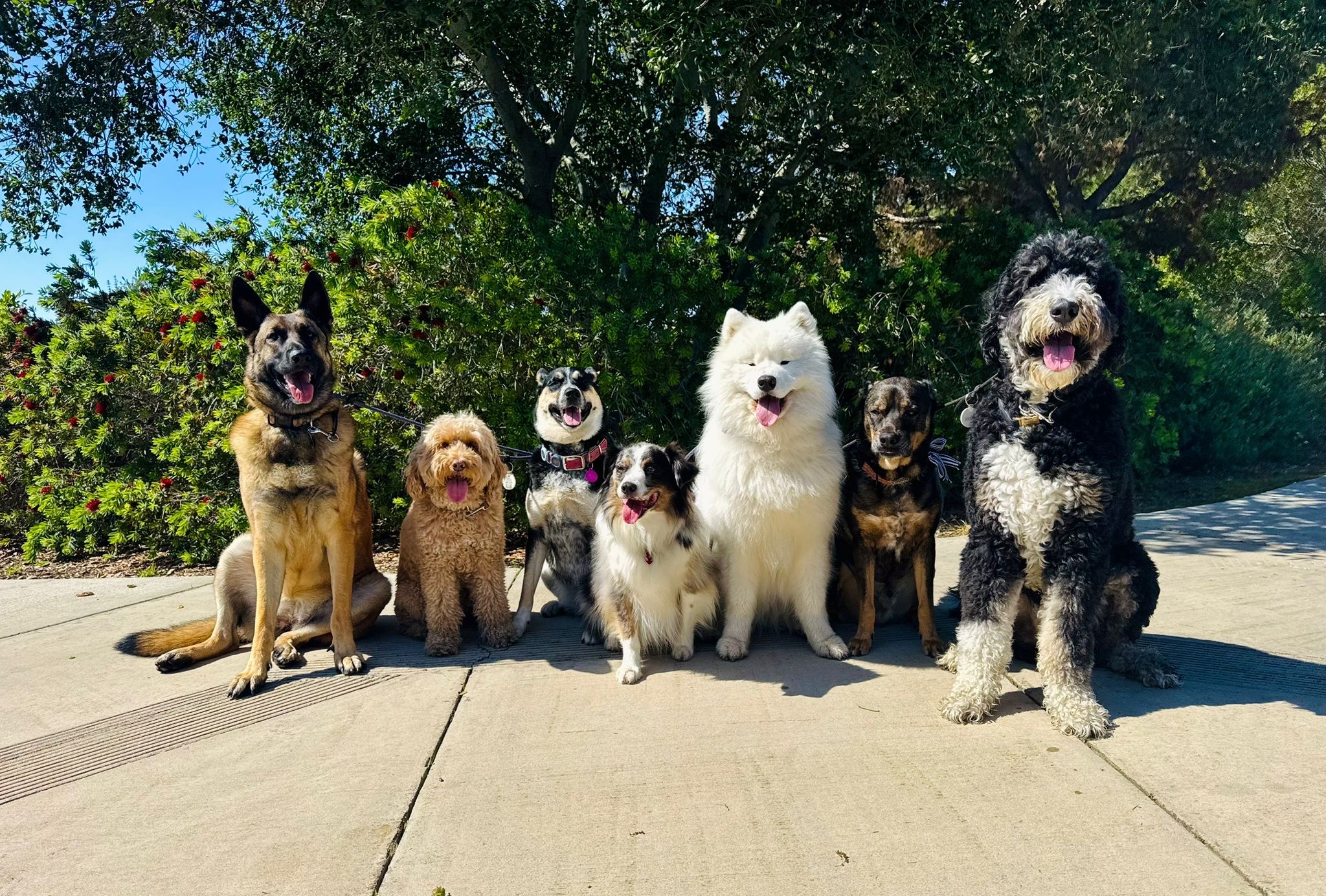
Seven dogs sit side by side on a concrete surface with green landscaping and trees in the background.
How to Decide: Four Scenarios
Real Orange County households. Real format matches.
Scenario 1: Coastal Commuter Family, One Dog
Dog: 4-year-old Golden Retriever, moderate energy, good leash manners, already trained through basics. Household schedule: Both adults work hybrid schedules. Home three days a week, office two days. Dog alone 6 to 7 hours on office days. Need: Consistent routine. Enough movement to prevent boredom. Not marathon-level exhaustion.
Match: Explorer Hour, Monday through Friday mornings. Pack Leader picks up at 8:30 a.m., returns by 10 a.m. Dog gets an hour of structured walking, practices recall at the park, comes home ready to nap through the workday. Weekends stay open for family beach outings.
Scenario 2: High-Drive Adolescent, Working-Line Breed
Dog: 18-month-old Belgian Malinois, boundless energy, good bite inhibition but needs constant mental engagement or becomes destructive. Household schedule: Single owner, works full-time in-office. Dog crated 8 hours daily. Evening walks help but do not tire the dog enough. Need: Heavy output. Mental fatigue layered on physical. Alternatives to daycare (dog got overstimulated in group play settings).
Match: Scout Expedition, Tuesday and Thursday. Four-hour outings replace the need for morning + evening walks on those days. Dog practices scent work, extended place holds, and trail walking with elevation. Comes home genuinely tired. On non-Expedition days, owner does short evening walks and puzzle feeders.
Scenario 3: Multi-Dog Household, Mixed Energy Levels
Dogs: 6-year-old Aussie (moderate energy, well-trained) and 2-year-old Border Collie mix (high energy, still learning impulse control). Household schedule: Stay-at-home parent, two young kids. Walking both dogs together is manageable but exhausting. The Collie pulls. The Aussie gets frustrated when the Collie misbehaves. Need: Separate the dogs for training-focused outings. Build the Collie's leash skills without the Aussie reinforcing bad behavior.
Match: Explorer Hour for the Aussie, Monday/Wednesday/Friday. Scout Expedition for the Collie, Tuesday/Thursday. Both dogs get structure tailored to their needs. The household gets breathing room. Over twelve weeks, the Collie's leash manners improve enough to rejoin the Aussie on weekend family walks.
Scenario 4: Senior Dog Transitioning Off Full-Time Activity
Dog: 10-year-old Labrador, arthritis managed with medication, still enjoys walks but tires faster than before. Household schedule: Retired couple, home most days. Used to walk the dog twice daily but the dog now struggles with heat and longer distances. Need: Maintain routine and social exposure without overexertion.
Match: Explorer Hour, three mornings a week during cooler hours. Pack Leader adjusts pace for the senior dog. Routes stay flat. Dog still practices leash skills and gets social time with the pack but does not push past comfortable limits. Post-walk notes track any signs of soreness or fatigue.
What Both Formats Do Not Include
No off-leash free play. No dog park stops. No unstructured mingling where dogs rehearse bad habits. Both formats are structured group outings led by a certified Pack Leader who reinforces training cues from start to finish.
If your dog needs off-leash running or wrestle sessions with other dogs, neither format delivers that. Pup Scouts dog walking in Orange County is behavior-first. Energy gets channeled through walking, scent work, and obedience intervals. Play happens at home or in private settings the owner controls.
When to Switch Between Formats
Dogs change. Adolescent energy peaks and then mellows. Senior dogs slow down. Household schedules shift.
Signs your dog needs Scout Expedition instead of Explorer Hour:
The dog still paces or whines after 60-minute walks. Destructive behavior increases on days the dog only gets Explorer Hour. The dog is a working-line breed entering the 12 to 24 month adolescent phase. Recall cues degrade because the dog does not burn enough mental energy.
Signs your dog should scale back to Explorer Hour:
The dog used Scout Expedition during adolescence but now tires appropriately with shorter outings. The household schedule stabilizes and daily routine becomes more important than exhaustive output. The dog is aging and cannot sustain 4-hour outings without soreness.
Pack Leaders track behavior notes over time. Families who book through the Pup Scouts client portal see trends in their dog's post-walk behavior. Switching formats is a conversation, not a fixed commitment.
Frequently Asked Questions
Can my dog do both Explorer Hour and Scout Expedition in the same week?
Yes. Many Orange County clients book Explorer Hour three mornings a week and Scout Expedition once or twice weekly. The combination works well for high-energy dogs whose owners want daily structure plus heavier output days. Pack Leaders coordinate schedules to avoid back-to-back long outings that risk overexertion.
How quickly will I see behavior changes with either format?
Most dogs show improved leash manners within two weeks of consistent outings. Recall reliability and neutral greetings take four to six weeks of repetition. Scout Expedition accelerates behavior improvements because dogs practice more cues per outing across more contexts. Explorer Hour builds incrementally but still delivers measurable progress over the same timeline.
What happens if my dog cannot keep up with the pack on a Scout Expedition?
Pack Leaders adjust pacing for individual dogs. If a senior dog or small breed joins a Scout Expedition group, routes include rest intervals and the pace slows at hills or long stretches. Dogs are never pushed past safe limits. Post-walk notes flag any signs of fatigue and the Pack Leader recommends format adjustments if needed.
Do you mix Explorer Hour and Scout Expedition dogs in the same group?
No. Groups are format-specific. Explorer Hour dogs walk with other 60-minute dogs. Scout Expedition dogs join 4-hour groups. This keeps pacing consistent and prevents one dog's energy level from disrupting the structure of the outing.
How do I know which format my dog needs if I have never tried either?
Book an in-home assessment. A Pack Leader meets your dog, observes behavior, asks about exercise history and household schedule. The assessment includes a 20-minute test walk to gauge leash skills and energy output. Based on that session, the Pack Leader recommends Explorer Hour, Scout Expedition, or a trial period alternating both formats to see which one fits.
Written by Mike and Colleen Bass, founders of Pup Scouts. Mike and Colleen have led structured dog care across Maryland, Orange County, and Charlotte since 2015. More about our team.
Get started with OC Pup Scouts, or call (949) 629-0932. Find us on Google as OC Pup Scouts.
Similar Blogs


