Dog Walking in Towson for Senior Dogs
Mike and Colleen Bass
Pack Walking

Key Takeaways
Dog walking for senior dogs in Towson builds routine without rushing, matching movement to energy capacity and joint health.
Pack Walking Adventures group senior dogs by temperament and mobility level, keeping the outing social but controlled.
Towson's residential grid near Goucher College and tree-lined streets like Stratford and Stevenson offer flat, shaded terrain ideal for senior dogs.
Towson mornings are measured. Neighbors walk to Towson Town Center. Students head toward Goucher College. Residential streets like Stratford and Stevenson stay quiet past 9 a.m. The pace here fits a senior dog. A ten-year-old Lab doesn't need the chaos of a dog park. She needs the structure of a walk that moves at her speed and gives her the companionship of other dogs who won't pull her forward or knock her off balance.
Pack Walking Adventures in Maryland are built for exactly this. Senior dogs join temperament-matched groups where energy levels align. The route doesn't sprint. The Pack Leader watches gait, reads fatigue, adjusts the return loop if needed. No one gets left behind.
What Dog Walking Means for Senior Dogs in Towson
Dog walking for senior dogs is structured movement designed around joint health, pace management, and social engagement without physical stress. In Towson, where sidewalks are wide and tree cover keeps routes shaded, it's a service that honors a dog's age without isolating them from the benefits of group time.
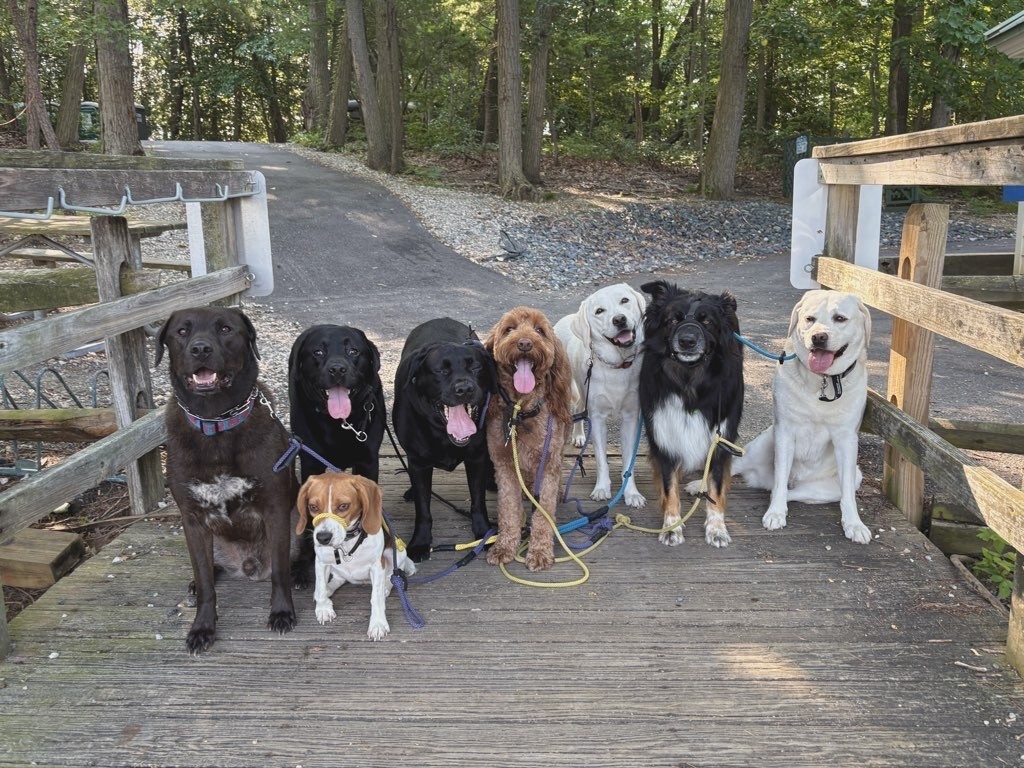
Seven dogs of various sizes and colors stand together on a wooden boardwalk, each on a leash with their Pack Leader.
Why Senior Dogs Still Need the Pack
A twelve-year-old Retriever doesn't want to stay home alone while her owner works. She wants to move. She wants to see other dogs. She wants the mental engagement of new scents on a familiar block. Sitting on the couch doesn't meet those needs.
Pack walks for senior dogs give structure without demand. The group size stays small. The pace matches the slowest dog. The Pack Leader positions the senior dog at the front or side, not in the middle where faster dogs might crowd. On a Towson route along Stratford, the group pauses at crosswalks longer than younger packs would. That pause is built into the walk. It's not accommodation. It's the design.
Social confidence matters at every age. A senior dog who walks with two or three calm peers every week doesn't lose her ability to read other dogs. She stays engaged. The walk reinforces composure, routine, and presence in the world.
How Towson's Terrain Supports Senior Dog Mobility
Towson is flat. The residential streets near Goucher College don't have the steep inclines of Roland Park or the broken sidewalks of older Baltimore neighborhoods. Stratford, Stevenson, and Bosley all run straight and level. Tree canopy keeps summer heat manageable. Grass strips between sidewalk and curb offer softer footing when a dog needs it.
Terrain feature | Why it matters for senior dogs |
|---|---|
Flat, even sidewalks | Reduces joint stress; prevents stumbles on uneven pavement |
Tree-lined streets | Keeps routes cooler in summer, reduces panting and overheating |
Residential density | Fewer car interruptions; calmer environment for slower-paced groups |
Grass buffer zones | Offers optional soft-surface walking for dogs with arthritis or hip dysplasia |
The Five Stages of a Senior Dog's Pack Walking Progression
Senior dogs don't decline uniformly. Some slow gradually. Some stay spry until their last year. Pack walks adapt to where the dog is in that progression.
Active senior (ages 7 to 9). Full-mile routes. Standard pack size. Energy still high, joints still sound. The dog walks the same structure as younger dogs but gets positioned for calm, not competition.
Slowing senior (ages 10 to 11). Routes shorten to three-quarters of a mile. Pack size drops to three or four dogs, all similar pace. More frequent water stops. Gait monitored weekly.
Limited mobility (ages 12 to 13). Half-mile routes. Pack size two or three. Grass-surface walking prioritized. Walk frequency may drop to three times per week instead of five to allow joint recovery.
Companion stage (age 14+). Quarter-mile neighborhood loops. One or two dogs max. Walk becomes presence and routine more than exercise. Still structured, still social, but the goal shifts to mental engagement and companionship.
End-of-life support. Some dogs reach a point where they can't walk but still benefit from being near the pack. In rare cases, the Pack Leader brings the group to the dog's yard for a five-minute greeting. It's not a walk, but it's still the routine.
Most dogs move through stages one through three. Stage four is less common. Stage five happens only when a family specifically requests it and the dog is comfortable.
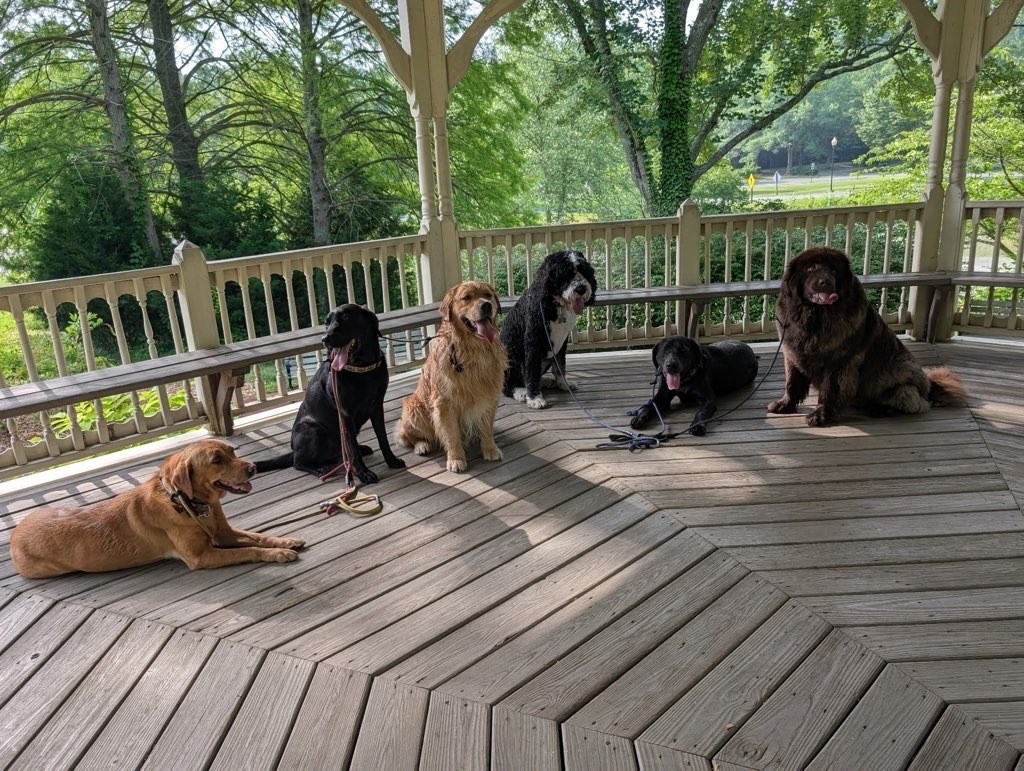
Six dogs rest together on a wooden deck surrounded by trees and railings.
What Towson's Residential Quiet Adds
Towson isn't busy the way Fells Point or Federal Hill is. The morning commute clears by 8:30 a.m. Afternoon traffic stays on York Road, not the side streets. A senior dog doesn't get startled by delivery trucks or groups of runners every block. The environment is predictable.
Predictability matters for older dogs. A ten-year-old Shepherd who used to handle urban chaos fine may now startle at sudden noise. Towson's residential grid removes most of that noise. The Pack Leader can focus on gait and pacing instead of constantly managing environmental triggers.
Goucher College sits adjacent to many of the residential streets we use. Campus foot traffic is light outside of class-change hours. The perimeter sidewalks offer long, uninterrupted stretches where a senior dog can settle into rhythm without stopping every fifty feet.
From Isolated to Included
A senior dog who stops going on walks doesn't just lose exercise. She loses her place in the household routine. She sleeps more. She disengages. The family feels guilty but doesn't know how to walk her at the pace she needs while also managing their own schedules.
Pack Walking Adventures solves that. The dog goes out three to five times per week. She moves at her speed. She sees other dogs. She comes home tired in the right way, not exhausted. The family gets updates after every walk. If the Pack Leader notices a limp or hesitation, the family knows that day. Adjustments happen in real time.
A twelve-year-old dog in Towson who rejoined the pack after a year of staying home didn't magically get younger. But she got her routine back. She got her confidence back. She got her place in the week back. That's what structured movement does.
Frequently Asked Questions
Will my senior dog keep up with younger dogs in the pack?
No. Senior dogs walk with other senior dogs or calm, slower-paced dogs. We don't mix a twelve-year-old Retriever with a two-year-old Shepherd. Pack composition is temperament and energy-matched, not age-matched, but the result is the same: your dog walks at her speed.
What if my dog has arthritis or hip dysplasia?
We adjust routes to prioritize grass-surface walking and shorten distance as needed. The Pack Leader monitors gait every walk. If your dog favors one side or shows discomfort, we notify you that day and reduce the next walk's length. Movement stays beneficial, not painful.
How do you know when a senior dog needs a break?
The Pack Leader reads panting, gait changes, and engagement level. If your dog lags behind the group, sits down mid-route, or loses interest in sniffing, that's a signal. We don't push through it. The walk shortens or pauses. Some senior dogs need a recovery day between walks. We build that into the schedule.
Can my senior dog start pack walks if she's never done group walks before?
Yes. We start with a shorter route and a smaller group, usually one or two other calm dogs. The first walk is an assessment. If she handles it well, we continue. If she shows stress, we adjust. Many senior dogs who've been solo walkers their whole lives adapt quickly to a calm, structured pack.
What happens if my dog can no longer walk at all?
At that point, pack walks end, but overnight boarding in Towson can still provide companionship and routine in a home environment if the family needs care coverage. Some families transition to private in-home visits where the Pack Leader spends time with the dog without a walk. We adapt to where the dog is.
Written by Mike and Colleen Bass, founders of Pup Scouts. Mike and Colleen have led structured dog care across Maryland, Orange County, and Charlotte since 2015. More about our team.
Get started with MD Pup Scouts, or call (410) 980-7855. Find us on Google as MD Pup Scouts.
Similar Blogs


