Dog Walking in Maryland: The In-Home Assessment
Mike and Colleen Bass
Pack Walking

Key Takeaways
The in-home assessment is a 20 to 30 minute observation where a certified Pack Leader meets your dog in your space before any walk begins.
We observe threshold behavior, leash response, social cues, and household routine to determine whether pack walking, private walking, or training is the right starting point.
Assessment findings shape your dog's service plan. Pack composition, walking route, and handling adjustments all trace back to what we observe during this first visit.
A front door opens in Annapolis. A dog barks once, then holds at the threshold while the owner greets the visitor. That hold. The two-second pause before lunging or retreating. Tells a Pack Leader more than a questionnaire ever could.
Before any Maryland dog joins a Pack Walking Adventure, a certified Pack Leader conducts an in-home assessment. It's not a sales pitch. It's an observation session. Twenty to thirty minutes where we meet your dog in the environment where behavior starts: your home.
The In-Home Assessment Defined
The in-home assessment is a structured observation visit conducted by a certified Pack Leader at your home before your dog's first walk. It evaluates threshold manners, leash response, social signals, and household routine to determine the right service match and handling protocol for your dog.
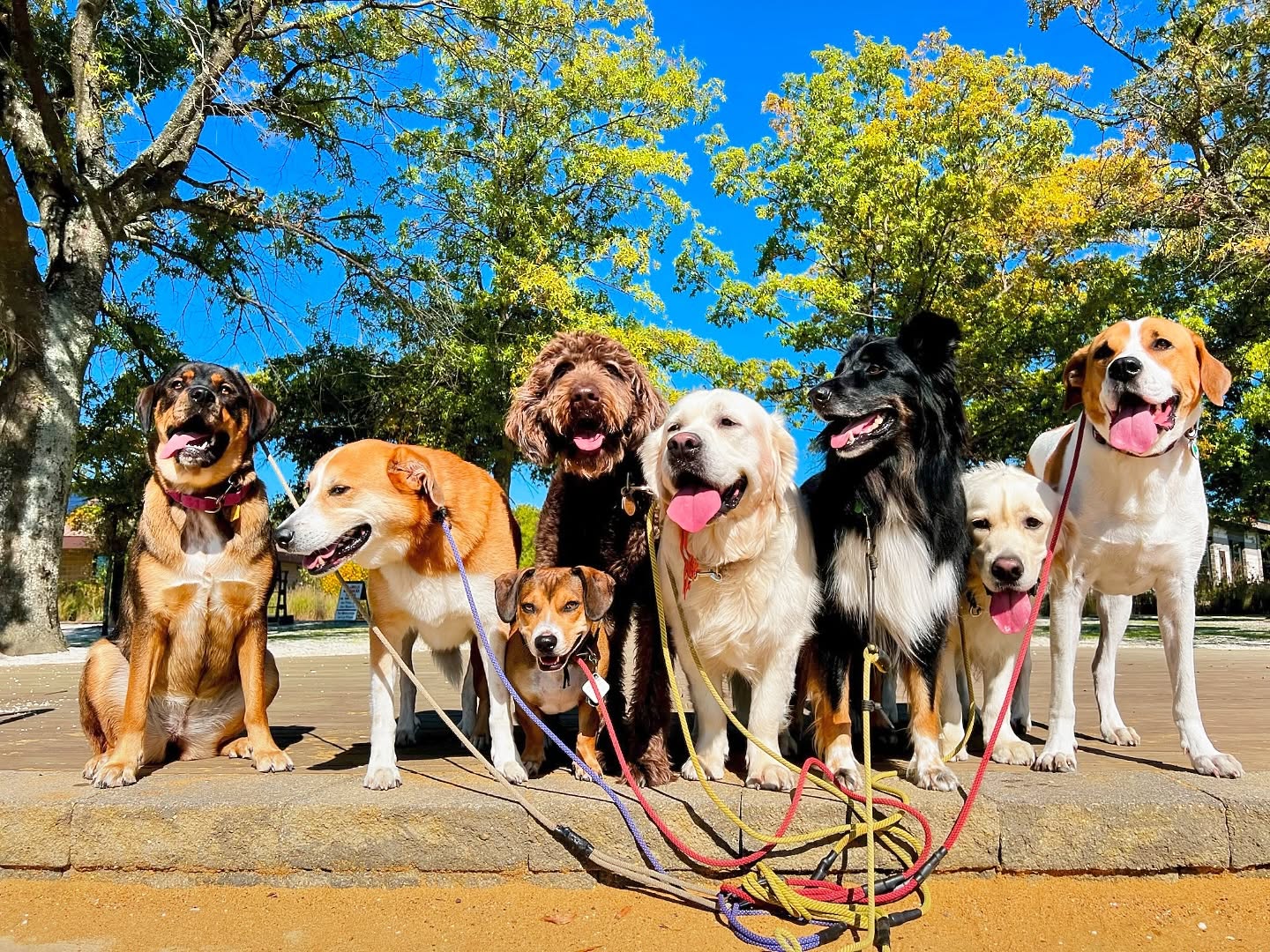
Eight dogs of various sizes and colors stand side by side on a paved surface under trees on a clear day.
What We Observe During the First Visit
The assessment follows a sequence. A Pack Leader arrives at a scheduled time, knocks or rings the bell, and watches what happens next.
Threshold behavior. Does your dog hold position, or does the door opening trigger a sprint? Does your dog bark once and settle, or escalate into sustained alerting? We're watching arousal management. How quickly your dog processes a novel stimulus and returns to baseline.
Leash response. The Pack Leader asks to walk a short loop around the block or down the driveway. We observe pulling intensity, distraction recovery, and whether your dog checks in with the handler. A dog who pulls hard but reorients when called reads differently than a dog who pulls and disengages entirely.
Social signals with a stranger. Does your dog approach the Pack Leader, or retreat? Does your dog solicit interaction, or tolerate it? We're reading confidence and stress markers. A wagging tail with a loose body versus a wagging tail with a stiff spine. Both wag. Only one is relaxed.
Household routine cues. We ask about your dog's daily schedule: meal times, walk times, when your dog is crated or free-roaming. Routine-rich households produce dogs with clearer behavioral baselines. A dog who knows what to expect regulates better in group settings.
How the Assessment Determines Service Fit
Not every dog starts with pack walking. The assessment maps behavior to the service that builds the right foundation.
Pack walking candidates. Dogs who hold a loose leash, recover quickly from distractions, and show neutral-to-positive interest in the Pack Leader during the assessment typically start with pack walks immediately. These dogs benefit from structured social exposure and real-world practice.
Private walking candidates. Dogs who show reactivity to other dogs on the assessment loop, or dogs with pulling intensity that suggests they'd destabilize a group, begin with private walks. Private walks let us isolate and address leash skills before introducing pack dynamics.
Training-first candidates. Dogs who can't hold threshold position, dogs with severe stranger fear, or dogs with aggression history start with in-home training sessions before any walking service begins. Training builds the composure the dog needs to succeed in movement-based care.
The assessment isn't pass-fail. It's diagnostic. We're determining where your dog is now so we can meet them there and build forward.
The Assessment Report: What You Receive
Within 24 hours of the visit, you receive a written assessment summary. It includes:
Behavioral observations from threshold, leash walk, and social interaction.
Service recommendation with reasoning (pack, private, or training-first).
Pack composition notes if your dog qualifies for pack walking. Size bracket, energy match, temperament profile.
Handling adjustments the assigned Pack Leader will use on walks. Leash length, pacing strategy, redirection cues.
Timeline to first walk. Typically 3 to 5 business days for pack walk onboarding, 1 to 2 days for private walks.
The report documents what we saw. It also sets expectations. If your dog needs two weeks of private walks before pack introduction, the report explains why and what we're building toward.
Service Pathways: How Dogs Progress
Service pathway | Assessment findings | First 30 days | 60 to 90 days |
|---|---|---|---|
Direct to pack walking | Neutral leash manners, recovers from distractions, social confidence with handler | Joins temperament-matched pack, 3 to 5 walks per week, post-walk behavior notes track progress | Graduated to larger or higher-energy pack if behavior supports it, or continues in stable group |
Private → pack transition | Leash pulling or mild reactivity, needs isolated skill-building | Private walks 2 to 3× per week, focus on loose-leash and distraction work | Graduates to pack walks once leash skills stabilize and reactivity decreases |
Training → private → pack | Threshold reactivity, stranger fear, or aggression markers | Weekly in-home training sessions, no walks until foundational composure improves | Transitions to private walks, then pack walks as training benchmarks are met |
The pathway isn't rigid. A dog who starts in private walks and shows rapid leash improvement can join a pack in two weeks. A dog who struggles with group dynamics can step back to private walks without penalty. The assessment establishes the starting point. Ongoing observations determine the next step.
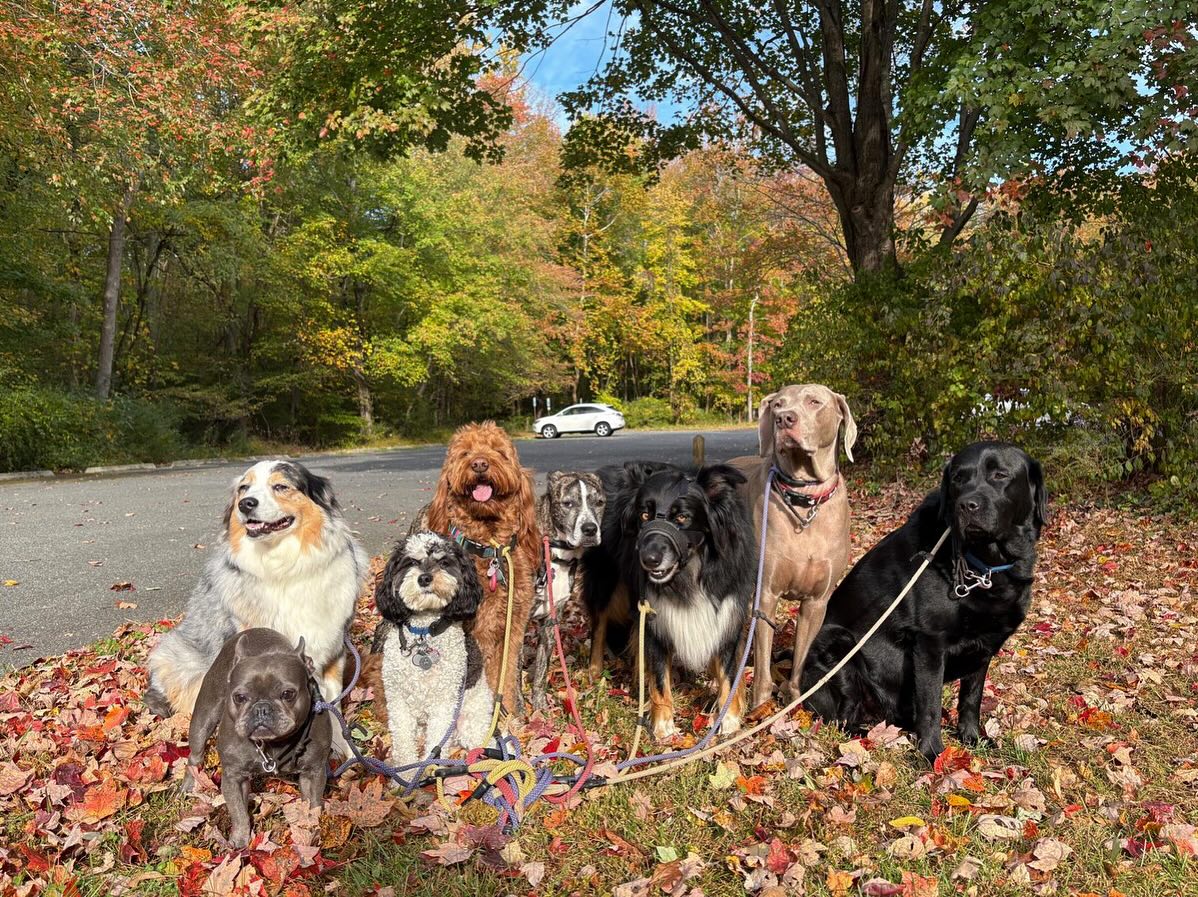
Seven dogs of various sizes stand together on a leashed pack walk on a tree-lined road.
What the Assessment Doesn't Cover
The in-home visit is a snapshot, not a diagnostic session. It doesn't replace veterinary behavior consultation, and it doesn't address medical concerns. If your dog shows signs of pain-related reactivity (snapping when touched, reluctance to move, limping), we recommend a vet visit before scheduling the assessment.
The assessment also doesn't predict every pack-walk scenario. A dog who seems calm in the home may show reactivity to squirrels on the trail. A dog who pulls on the assessment loop may settle beautifully in a group. The first walk extends the assessment. We're still learning your dog.
Why Maryland Households Value the Assessment
Maryland dog owners work long hours. Commutes to DC, Baltimore, and Annapolis mean dogs spend extended time alone. The in-home assessment answers the question most pet parents ask: Will this work for my dog right now?
We've conducted assessments in Severna Park rowhouses where three dogs share 1,200 square feet. We've assessed dogs in Bethesda estates with acre lots. The space doesn't determine pack readiness. The behavior does.
One client in Fells Point told us their dog had been dismissed from two daycares for "dominance issues." The assessment revealed a dog with poor play-brake skills. Not aggression, but over-arousal in unstructured group settings. That dog started with private walks, learned to regulate around distractions, and joined a pack three weeks later. The assessment gave us the context daycare intake forms missed.
From Assessment to First Walk
The assessment closes with next steps. If your dog qualifies for pack walking, you'll receive:
Pack assignment. The group your dog will join, with names and temperament notes for the other dogs.
Pack Leader introduction. The handler who will walk your dog. Same person, every time.
Route preview. The neighborhood loop or trail system your dog's pack uses.
First walk scheduling. Typically within 3 to 5 business days.
If your dog starts with private walks or training, you'll receive a timeline and session frequency recommendation. Private walk clients typically transition to pack walking within 30 to 60 days. Training clients vary. Some dogs need six weeks of foundation work; others need six months.
Frequently Asked Questions
What happens if my dog doesn't pass the assessment?
There's no pass-fail. Every dog receives a service recommendation. If pack walking isn't the right starting point, we recommend private walks or training and explain what we're building toward. You're never turned away. We adjust the service to fit your dog's current skills.
Can I be present during the assessment?
Yes, and we encourage it. Most assessments happen with the owner present for the threshold and leash portions, then the owner steps aside for the social interaction observation. Your presence helps us understand how your dog behaves with you nearby versus when you're not in the room.
How long before my dog can start pack walks if they begin with private walks?
Most dogs transition within 30 days. Some take 60 to 90 days if leash reactivity or anxiety requires more gradual desensitization. The assigned Pack Leader provides weekly progress updates so you can track the timeline.
Do you reassess dogs periodically?
Informal reassessment happens on every walk. Pack Leaders document behavior changes in post-walk notes. Formal reassessment occurs if a dog shows regression (new reactivity, refusal to walk, stress signals) or if you request a service change (moving from pack to private, or vice versa).
What if my dog's behavior changes after the assessment?
Contact us immediately. Behavior changes can signal medical issues, environmental stressors, or developmental shifts (especially in adolescent dogs). We'll schedule a follow-up visit to reassess and adjust the service plan. There's no penalty for pausing or changing services based on your dog's needs.
Written by Mike and Colleen Bass, founders of Pup Scouts. Mike and Colleen have led structured dog care across Maryland, Orange County, and Charlotte since 2015. More about our team.
Get started with MD Pup Scouts, or call (410) 980-7855. Find us on Google as MD Pup Scouts.
Similar Blogs


